Remembrance Day, the 11th of November every year, is the day on which all Australians are asked to remember those who ‘died or suffered for Australia’s cause in all wars and armed conflicts.’ The day has waxed and waned in importance over the decades, reflecting perhaps the declining numbers of the First World War veterans and casualties who it originally commemorated. In more recent times it has passed not unnoticed, but certainly in the background of current events and concerns. Anzac Day has more of the national focus on remembering those who served and died. Indeed, a couple of years ago at the Australian Defence Force Headquarters Remembrance Day service at Russell Offices, a young Australian Public Servant I was walking past poked his head out at the sound of the Last Post reverberating between the buildings and asked ‘What are they doing that for?’. It’s not as bad a question as it first sounds.

While Remembrance Day may lack the national significance of Anzac Day, it can still play an important part in our collective psyche and consciousness. For me it is a different type of day. Rather than the solemn pride of the Anzac Day dawn service and march, the re-connection with comrades-in-arms and the raucous celebration of having survived the worst of the world that follows, I find Remembrance Day to be a time of quieter contemplation and commemoration of those I served with, the countries we deployed to, our service, sacrifice, coming home and life after. I’ll remember as many people and places as I can.
I’ll remember serving at the School of Infantry in Singleton and the lanky frame of a trainee filling the office door during the final weeks of one course. The trainee had injured his back a few days beforehand. We were about to embark on the final activity for that training platoon, a physically and mentally demanding training evolution called Exercise Hard Core that was designed to test the trainee’s knowledge on the gamut of tactics, weapons and situations they had trained on over the past couple of months. The trainee wouldn’t be able to complete the exercise due to his injury. However, such was the effort he had put in, the results he had achieved and the regard he was held in by the training staff we had tried to get him waived for the final exercise by the Commanding Officer.
The request was (rightly) denied and I had to break the news to the trainee. He would be placed with the next platoon in the training cycle who were a couple of weeks behind in the program. I apologised to him, told him he would excel as a soldier and gave him our regards. Our platoon staff came up to shake his hand and wish him well. The kid was a natural soldier and a great bloke. He took the bad news in his stride and excelled with his next platoon as well. The following year we bumped into each other briefly in East Timor. He was heading into country as I left. We chatted quickly, and he mentioned he was going to try Special Forces selection as soon as he could. From what I’ve heard he excelled there as well, right up until he was killed in action protecting his mates. Private Luke Worsley was 26 years old when he died in Afghanistan.
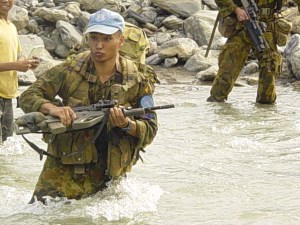
I’ll remember charging down a hill in the East Timorese jungle; rushing with my platoon to meet a rendezvous with a Troop of Armoured Personnel Carriers. For six days we – and other members of our Company and Battalion – had been in pursuit of a group of armed militia who had infiltrated the border and shot up a local bus killing a number of people. The group had been tracked to a new area and we were deploying to ambush positions. We jammed into the carriers in some sort of order and I commenced relaying our new instructions over the radio. I’ll remember a young Digger looking at me as we bounced through the rough jungle tracks in the carriers and asking “Boss what do we do if they walk into the ambush?”
“We give them the warning, and if they fight back, we drop them.” I replied with more confidence in our Rules of Engagement than I actually felt. I’ll remember that same Digger patting me on the head with a cheeky ‘Nice try boss’ at a Officers Versus Soldiers rugby game after he had absolutely smashed me. I’ll remember hearing how the Digger, Private Scott Palmer, died in a helicopter crash in Afghanistan in June 2010. I’ll remember the raw grief and sorrow on his parents faces at the memorial service in Darwin. Scott was 27 years old when he died.
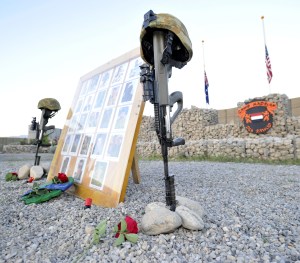
I’ll remember waiting to board a helicopter from Tarin Kowt back out to Deh Rawood when an Australian medic, Kerrie L. rushed out and grabbed me. “There’s been an IED strike in your area. Some of your soldiers are dead. The helicopter is coming in soon.” I raced to the Command Post and then down to hospital. All I knew for certain was that one of my Combat Engineers had been killed and another wounded – potentially seriously. As the names of the casualties were confirmed I paced relentlessly outside. I’ll remember the ambulance pulling in and the broken body of Corporal Richard ‘Akka’ Atkinson being gently removed. I’ll remember holding the door of the ambulance open so that nothing was caught on it. I’ll remember nurse Erica gently tugging on my sleeve and suggesting that I should be the one to tell Sapper Robert Rose, the injured soldier, that Akka was dead. That it was better coming from me than someone he didn’t know. I’ll remember the look on Rosey’s face as I did just that, then having to walk away before I broke down myself. Akka was only 22 years old when he was killed.
I’ll remember writing to Akka’s parents that night and the quiet, humbling dignity and grace they displayed in their own reply and in every interaction we had with them since. Members and leaders of a community they have no wish to be part of. Their own type of bravery was immense. I’ll remember the quiet and intense pride that Akka’s brother James had as he marched with us 5 years later in Launceston on Anzac Day, holding his brother’s portrait as he led us down the streets. I’ll remember visiting Akka’s grave there and, for once, being lost for words as our team stood together once more.

I’ll remember on so many occasions the bravery and compassion of our soldiers on operations in often hostile environments. Of asking ‘Langy’ “What are they doing down there?” as we manoeuvred in contact against the Taliban and his dry-as-the-Sahara reply of “Shooting at me.” I’ll remember one of our Medics Howey gently treating a scared Afghan boy with a cut on his foot, and that his success resulted in more patients than he knew what to do with. I’ll remember almost getting clobbered by an artillery shell that was off target (by one and a half kilometres!) and the fear that the mistake had wiped out one of our mentoring teams. Then the relief as we discovered we had somehow all survived.
I’ll remember these people and incidents and more. The next day I’ll remember something else or someone else. Not with sadness, but pride in our service and a commitment to honour those memories and to continue to assist our veterans. I’ll remember to enjoy every experience that I can have that others – like Scott, Luke, and Akka – perhaps never had the chance to and now never will. I’ll remember to be grateful for what I have and what may come.
I’ll remember that we did our best, we served with honour, and that there is so much life to live still.
Who will you remember?
 Tales Of A No One Soldier.
When I was a kid we all stopped for a minutes silence on Remembrance Day, and everyone did stop. Perhaps it was because the war in Vietnam was ongoing and the last world war was something our fathers fought in that it still meant something worth respect and silence. This was also when the Dawn Service was not the mass gatherings that have become popular in the last 20 years, rather it was usually a few dozen veterans and family standing in the cold and dark for the ceremony before going to the ‘rissole’ for the Anzac breakfast then back home to watch the big march in Sydney on TV and then all the propaganda movies dusted off and aired by the ABC. That was before the ABC became what it is today. One that stuck in my memory is the movie on the marvels of prefabrication when constructing new military bases as the campaign in the Pacific unfolded.
LikeLike