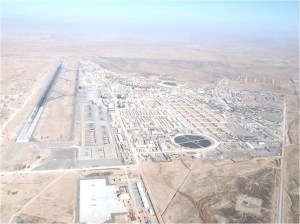
This year marks the 10th anniversary of my tour of Afghanistan, and it has been rather poignant time to reflect on a chapter of my service that fundamentally changed my life.
I was 38 years old when I deployed to Kandahar. I wear a blue uniform (RAAFie), I was an electronic warfare specialist, a single mum, and I said good bye to my 7 year old daughter on my 38th birthday – it’s hard to be strong when your little girl is balling her eyes out at the airport being sent somewhere she doesn’t want to go. But this was not the toughest part.
I was part of the Air Force’s Heron Unmanned Aerial System detachment, Number 5 Flight, and I was on Rotation 5 (ROT5). At the time I was a signaller or ‘sig’ and it was my first deployment. This is what I signed up for. I was excited, and for the first time in my career I was not part of a Joint or Tri-Service Unit. It was all blue, with the exception of two Army Aviation Officers as Payload Operators and Pilots. The pace was frantic from the get go, even on the weather induced no-fly days we were busy doing training and equipment checks. We had a really good team, and despite being strangers for the most part, we had a trust in each others’ roles and capabilities from the outset – courtesy of pre-deployment and work-up training drills.
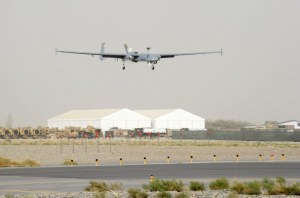
Heron was still trying to prove itself as a worthwhile capability, and ROT5 worked tirelessly on this, to the point it became a platform requested by Special Operations Task Group elements as part of their “go/no go” criteria. My electronic warfare team consisted of 3 uniformed personnel and a Language Cultural Advisor (LCA) who was Afghan born but a United States citizen. As our team’s and Heron’s reputation grew we found ourselves working 16-18 hour days, often 10-12 days straight. Once the most under-utilised capability of the Heron detachment, we became the most in-demand. As the leader for my team of skilled operators, it was often left to me to decide who to wake some for a crucial mission. I tried to always leave one team member to rest, but with only one operator, one LCA and a data analyst it tended to be the same two people who were woken every time with me right there with them ensuring they were fed and looked after while on task. I also did the end of night summary intel report so had to be there anyway!
This tempo made it hard to phone home and Skype with my daughter. She was suffering, having changed schools twice during my deployment as things did not turn out as planned in the first house. She was relocated to live with my sister and her cousins in another town. By the time I returned, she’d had three school changes in 5 months. But this was not the toughest part.
Australia lost a lot of men during 2011, and from April to August while I was there, ramp ceremonies for coalition and memorial services for our own at Camp Baker became all to regular occurrences. As their names were read out, and the details of the children and partners and parents and siblings that they’d left behind, I would shed a tear for them and feel guilty about missing my daughter. Emotions were varied and often hard to quantify or reason. This was still not the toughest part.
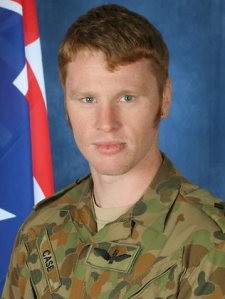
On 29 May 2011, I had my meal in the Red Mess (Asian style food). I rarely frequented this mess as it was the least convenient to where I lived and worked. My Heron teammate, Army Lieutenant Marcus Case, also happened to be eating in the mess that evening and I sat at his table with him and a few others. It was the first time I’d eaten a meal with Marcus in Kandahar as we were always on different shifts at meal times. He was excited about flying with his helicopter crew the following day, having been given a rest day and permission to fly by our Detachment Commander. He was beaming; grinning with excitement like a little boy. It was a memorable evening, and we spoke about anything other than our roles or our missions – it was a nice change.
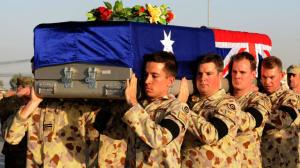
On 30 May 2011, Marcus was killed in a helicopter crash. That same day, Australian Army cook Lance Corporal Andrew Jones, on duty at a Combat Outpost in the Chora valley, was shot and killed in a ‘green on blue’ attack. Two men who were serving in roles that were not “outside the wire” and should not have been killed in the manner in which they were. A few days later we held the ramp ceremony for Marcus where his fellow Heron aviators carried his coffin as the rest of our team formed the honour guard. That was really, really tough, watching your teammate’s coffin being loaded onto the Air Force C-130 Hercules. The whole day was hard to make sense of and two days later, we were back on the job – as the mission and objectives were to prevent as many Australian deaths as possible through the support that the Heron provided. But the events of 30 May 2011, was not the toughest part.
Every day I was there, every shift, every mission, I felt I was contributing to something bigger than me. It was amazing. It was an all time professional high, yet personally challenging being so far away from my daughter. It had been just the two us for the past 6 years. She was hurting on the other side of the world and I couldn’t help her or hug her. My sister stepped up and looked after her after the first arrangement didn’t work out. Family support sustained me throughout. Returning to the mundane tasks back at my home unit was a struggle, they seemed pointless and without purpose. But this was not the toughest part.
The next 10 years I had many flashbacks to rocket attacks – attending fireworks was always interesting. Visualisations and nightmares of what Marcus and Andrew went through in their final moments, and what their families went through. It was unimaginable, but I tried to imagine it nonetheless.
So what was the toughest part? These past few years have been the toughest. My daughter has been seeing a counsellor, and I faced my own demons after one day shutting my office door, sitting in the corner and just crying for no apparent reason. I subsequently made a significant career change to spend more time with her – as I’d been too emotionally and geographically absent to notice she was struggling. She self harmed, we both suffered degrees of depression; hers was more severe than mine. I was convinced that as I personally didn’t lose anything I didn’t deserve to feel the way I did. But then I let it all go. I’m here, I’m healing and so is my daughter. We are going okay. Deployment wasn’t the toughest part – processing my emotions and allowing myself to not be okay was the toughest part.
There is no right way to feel, act, grieve, or process emotions. But recognise when you need help and go get it. Help doesn’t come to you – you have to seek it.
Lisa is a 24 year veteran of the Royal Australian Air Force. She has deployed to Afghanistan and completed exercises all over the world. Lisa has served as a signals and electronic warfare specialist, and her most recent postings have been as a Logistics Officer where she has recently led personnel initiatives for the Royal Australian Air Force.

