I never thought that tying my shoelaces would save my life. At least not in a warzone. I mean sure, my mother had said on any number of occasions to tie my shoelace before I tripped and broke my neck but . . . . . well getting saved by shoelaces in a warzone is a bit different.

That warzone was Baghdad, Iraq, in late 2007. I was finally back on operations, something I had been desperate to do since my return from Timor Leste in 2003. I’d lost the best part of the following two years to a shoulder injury and rehab, and then spent another year at language school studying Portuguese for an overseas posting back to Timor that never eventuated. After language school I was posted as part of a small team of watchkeepers supporting our deployed Special Operations forces. While the job might sound kind of exciting, the reality of it was 12 hour shifts in an underground bunker in Sydney. Through a combined effort our team managed to wrangle a short overseas tour in the Australian Joint Task Force Headquarters located on Camp Victory in Baghdad. For one reason or another, I got the gig. Right place at the right time? Random chance? I was stoked.
I arrived in Baghdad in the last days of August and just before what would become the dying days of September and October 2007. General David Petraeus was about to present to the United States Congress on the progress of the war since the implementation of the ‘Surge’. Perhaps in an effort to prove him wrong, insurgents decided to fire what seemed like every single rocket in their arsenal at us, or in our general vicinity at least.
Rocket attacks are indiscriminate, sudden, destructive acts of terrifying violence. They come without warning most of the time and can wreak terrible injuries to those in the wrong place at the wrong time regardless of what protective equipment you’re wearing. For the majority of locals working on the base and the contracted staff from other nations like India, Nepal and the Philippines who manned the kitchens, fulfilled the cleaning roles and the like, there was no such equipment.
Sometimes we did get warnings of these attacks though. The base was, in theory, protected by a Counter Rocket, Artillery and Mortar (C-RAM) system. Radars would constantly scan the sky for signs of incoming rockets. High-powered, rapid firing machine guns would immediately slew to the incoming rocket’s path letting flow a cone of outgoing bullets to destroy the deadly weapons. A tannoy would blare out ‘INCOMING, INCOMING, INCOMING’ to let the base occupants know to take cover in a bomb shelter or building. The latter was of variable use. It couldn’t say which direction the rockets were incoming from and as often as not the the tannoy would scream it’s warning after the rockets had impacted. Sometimes the machine guns hit the rocket. Sometimes they didn’t. The enemy gets a vote in war, as do the dice of chance and the randomness of life.
During night time attacks the trails of the rockets and the tracer from the outgoing bullets would light a beautiful arc of deadly intent through the sky. If a rocket was impacted by the bullets there would be a sudden and short fireworks display as the rocket met it’s demise. I never really heard it myself, but others swore they heard the clang of destroyed parts of the rockets impacting the grounds after they were shot down. On many evenings in September and October of 2007 the night lights of rocket and gunfire would light up the sky. Intense, bright. Deadly.
A few weeks into my tour in the Operations Cell of the Headquarters and I was a veteran of dealing with rocket attacks. This meant that I had got used to the idea of being randomly blasted out of the world at any given time. On 12 September, just after General Petraeus’ presentation to Congress, a rocket attack slammed into the base. I was working in the Australians Headquarters at the time and there was a short panic as we accounted for all hands. On this day, all Australians were safe and away from the point of impact. But 11 Coalition soldiers and one worker from India (I think), were not so lucky. The soldiers were wounded. For the worker, a guy who had rolled the dice of chance to earn better money for his family then he could have at home, his time was up. Wrong place. Wrong time. Wrong result. Gone.
When you are in a gunfight – a contact – you accept that there is a chance you might die. In some ways, as many others have written, you’ve already accepted you’re dead. You get a vote, the guy next to you does. The enemy gets a vote too. That worker from India didn’t get a vote. He was – to the best of my recollection – simply walking down a street when the rocket hit nearby, spraying him with deadly shrapnel and killing him. The randomness of it is vile, and it is no different to the civilians who are killed by coalition rockets going the other way. So it is in war that life, and death, turns on the the strangest things: the street you’re walking on, the building you’re sleeping in, when you bend down to tie your shoelaces.
A few weeks later and I was off shift. 12 hours on and 12 hours off sucked as much in Baghdad as it did in Sydney. On this day I’d gone to the gym after a shift – a welcome break and small freedom from the graft of work – and completed my version of a workout. The last part of this was the jog a couple of kilometers back to the ‘Tower’ where we lived. This was a small freedom in another way, it was one of the few times we didn’t have to carry our body armour and helmets. As I jogged back to get ready for the next shift I noticed my shoelace was undone. Remembering Mum’s advice I stopped to tie it up, checked the other one, picked my water bottle up and was about to set off. A swig from the water bottle and an adjustment to the iPod to switch off from a kids song that had snuck on there – I really didn’t need to listen to ‘C is for Cookie’ in Baghdad . . . or anywhere for that matter. About a minutes delay to my journey and maybe a couple of hundred meters and a few corners from where I would have been. Then the air shrieked as a barrage of rockets broke the base’s protective shield. The C-RAM returned fire, adding to the noise. ‘Ah fuck’ I thought. I was nowhere near a shelter or an open door. I could run but could just as easily run into a rocket as away from it. I hit the deck, covered my head and hoped for the best. The scream of the rockets and blast of the defensive fire merged into one and was then joined by the tannoy “INCOMING, INCOMING, INCOMING!”
“YEAH NO SHIT” screamed a voice from behind me. Or maybe it was mine?
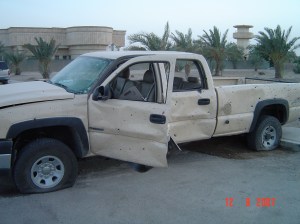
The barrage finished. Ears ringing, still nervous, I dusted myself off and started walking back to the Tower, moving a lot slower than before. As I rounded a corner to walk through a carpark I saw chaos and stopped in my tracks. A rocket had smashed into the cars and people there. Vehicles were in tatters Soldiers and civilians lay wounded, surrounded by others who were calmly, but with great urgency, treating them. Already ambulances had arrived and were loading up the bloodied, broken and shattered. Training kicked in and I went down to assist. A hand reached out and held me back “Nah bro. They’re good. They’ve got it. Let them do it.” The hand belonged to a Tongan soldier, one of 50 odd who were charged with the security of the nearby coalition force headquarters building. I nodded, shocked, and walked around the car park.
‘If I didn’t stop to tie my shoelace, I could have been there‘ was my immediate, and guilt ridden, thought. I got back to the Tower and started to get changed for my shift. I must have looked a tad worse than I thought as one of my fellow Captains asked my if I was alright and then “Where you out there? Was it bad?” “Yeah man it was bad” I replied. And it was. There were about 40 casualties that day around the base. A few dead, many seriously wounded. Maybe but for that shoelace I would have been one of them. Random chance? The wrong place at the wrong time? When that place and time was decided by a hundred meters, a random decision to tie a shoelace, the fact some guy aimed a rocket a bit more to the left than the right that day, it can be hard to comprehend.
I preferred getting shot at.
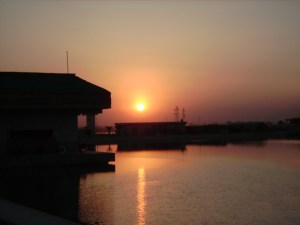
The rest of my short tour was pretty uneventful. On my second last night shift I was walking back from the Operations Room to the Tower, carrying my body armour and helmet. The night sky was just giving way to one of those beautiful Middle Eastern dawns with the sun cracking the horizon with a bright orange. A single rocket flew across the sky, intercepted by fire from the C-RAM that blasted the rocket into a brilliant firework above the base somewhere, the night lights fading to nothing. A farewell to Baghdad perhaps? I kept walking home. Then the tannoy blared out.
“INCOMING, INCOMING, INCOMING.”
 Tales Of A No One Soldier.
Pingback: Keep Your Tribe. | Tales Of A No One Soldier.