This year it is 18 years since I deployed to Iraq as part of the Special Forces Task Group. I was responsible for leading the psychological operations (psyops) detachment and we were tasked with creating and disseminating psyops material through the Australian Area of Operations to encourage peaceful surrender.
I have never been one to say much about my deployment but when people do find out I spent time over there, the inevitable question is ‘What was it like?’.
When I go to answer, I often think about how naive I was as a 24-year-old heading off to fight in a war without stopping to think about why we were going or the consequences of our involvement. But we weren’t trained to question and when I was issued my warning order, I genuinely (or naively) felt like it was the culminating point of my years of training. The ensuing five months went by in the blink of an eye and yet the events I was a part of had a resounding impact on that region and indeed the world for years to come.

When we first arrived in country, the whole of our Australian Task Force (TF 64) was on a total communications black out for about 8-9 weeks, unable to speak to our loved ones. We either worked, or we slept. There was very little downtime and the tempo of operations we worked under was crippling. My team worked our arses off for 20 hours a day for the majority of the deployment to soften the battlefield for our fighting forces. The psyops we produced were so successful the US Task Force asked us to extend support to their area of operations, so we worked longer hours and slept ridiculously little.
The heavy workload took its toll on all of us. I was extremely resilient and rarely emotional but I remember the day the communications black out lifted and I was able to call home. I struggled to get the words out when I heard my parents’ voices on the line. I was so tired and the weight of home sickness and deployment stress was palpable not just for myself but for my parents as well.
As the deployment moved on, I was given regular reminders of how serious what we were doing was. No training can really prepare you for those moments.

In an Operations Group meeting in the days after Australian troops crossed the border into Iraq, I learned I was responsible for the death of the first enemy combatant for Australia. How? One of my static line psyops boxes failed to open when it was thrown out of the plane and crushed a man from 1500 ft. The mood in the Operations Room was pretty jovial. I was surrounded by experienced soldiers and officers who were familiar with the taking of enemy lives and this almost sounded funny when the Operations Officer read it out. Except it wasn’t.
About midway through my deployment my team and I all nearly died when a surface-to-air missile came within a metre or so of taking out the aircraft we were disseminating our psyops from. As the missile shot passed the open tail gate of the plane, I realised I remembered none of the downed aircraft drills. I couldn’t even remember the duress password I had registered in case I was captured by enemy forces. Thankfully the skilled flying of the pilot got us out of harms way and I pushed down the stress of that experience to the bottom of my mind. In the days after, one of my soldiers was openly struggling with how close we came. I stood with him in an empty tent and made light of it – “We got out and what a story we have to tell”. I think I was trying to convince myself as much as him.
I also remember standing in the Operations Centre for the Combined Joint Special Operations Task Force with my US counterpart, watching coalition forces on the big screen roll into Baghdad. I saw locals waving the psyops leaflets we had dropped into Baghdad encouraging locals not to take up arms against the coalition forces. For a brief moment I was proud of my part to play in that….. Until that ‘iconic’ moment when the US forces dragged down the statue of Saddam and draped the US flag over the top. In that instant, the doubt I had been struggling with about the reasons for our deployment came right to the surface. We weren’t there to save the world from a dangerous dictator and we sure as shit weren’t there to save the world from Saddam’s weapons of mass destruction. This was just about politics and forcing a regime change.
So, when I am asked about what my deployment was like, I struggle to articulate much relating to why we were there. I hold no pride in my part in that war, but that is not to say I don’t have some cracking memories and that is what I choose to focus my memories on.

I choose to tell people about the never-ending dust storms that would sweep in and destroy our base at least once a week. Like an Armageddon wave of dust and wind that would tear through our stuff and leave anything not tied down KM’s away. We learned to lock everything down in our trunks and roll up our bivvy bags in a tight ball to make it easier to remove the thick inch of dust that would end up layered over everything. We went everywhere with ski masks and scarves so that when the dust storms hit we could still get around, my team would often work under multiple layers of plastic to protect equipment and still get the job done.

Sometimes I might tell the story about the 3 marriage proposals I got from some crafty locals who were probably just trying to hitch their wagon to the first female they had seen in months. Or I will describe what it was like to have Anzac Day on land that was part of the occupied area for the Australian Light Horse in WW1. No Anzac Day will ever match the significance of that services.
Sometimes I tell them about the horrors of having to use portaloos for over 5 months. I don’t know what is worse……having to drop your pants in a portaloo in minus 11 degrees, having to enter a portaloo in the middle of a middle eastern summer day (50 degrees) or maybe it was when the locals forgot to empty them for 4 days and they became so full you couldn’t sit for fear the contents would touch your bare backside.
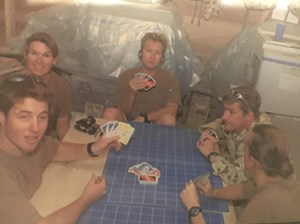
I often tell my kids about the MEAO Uno Challenge we started in our very little downtime (because sleep was too hard to find). I honed my take no prisoners Uno skills and it gave us a rare opportunity to relax. We played for sheep stations and bragging rights as Aussie’s do, and my kids still hate playing Uno against me as a result.
I talk about how grateful I was to receive the constant flow of care packages from home. My mum’s amazing chocolate slice…always a little stale when it arrived because of the time it took to get to us but still tasted bloody good. Trashy magazines, newspapers, books and letters were read by everyone. I also taught myself to juggle in the 5 months I was away. My netball coach had challenged me to keep my hand eye coordination up by learning to juggle and so I taught myself whilst I stood at the printer waiting for reams of psyops leaflets to finish printing.
But perhaps my favourite story to tell is about our shower facilities. Specifically about the day we all realised the same shit truck that was emptying our portaloos was coming back later in the day to fill the water tanks up for our showers. I will never forget the dawning realisation on everyone’s faces when we all grasped we had been showering with water from the shit truck for weeks. Only in the Middle East.
Those memories are the ones I choose to talk about. They are the ones that show the other side to life on a deployment. And they are the stories I ask other veterans to tell me. Tell me the stories of everyday life whilst you were away…..

Amanda Creevey served as an Intelligence Officer in the Australian Army for 12 years and deployed to Iraq in 2003. Now an Executive Manager in the utilities industry and part-time Director in the not for profit section, Amanda is an advocate for better mental health support for veterans, wife of a Timor and Iraq veteran, part time dance mum, netball coach and Mum and Step-Mum to four.
 Tales Of A No One Soldier.
Amanda, I am very proud, and consider it my good fortune to have served with you.
LikeLike
Hey Amanda. I love the stories and in parts while reading, I felt like I was there experiencing them also. These experiences are unique to a few but you have shared to to the many which may help to bridge the gap between veterans healing and others understanding. Nice work Amanda thank you for your service!
LikeLike