Every Anzac Day at the dawn, and in hours after, we gather to commemorate the service and sacrifice of all Australians who have fought and died in our country’s name. From the largest city squares and shrines to the smallest country town roundabouts where stand the ancient obelisk’s bearing faded names; the hill tops and streets all become something sacred as they witness the dawn vigil, the mournful tones of the bugle and the parade that follows. And as we stand on what becomes hallowed ground for that time and that day, we do our best not to forget.
We stand united. The old and the young of years, the newest of Australians and those from our First Nations people and everyone in between. Immigrants and settlers, Aboriginals and Torres Strait Islanders, farmers and townies, descendants of convicts and ten-pound Poms – all sons and daughters of Anzac. We stand on that hallowed ground, in our country by whatever name we know it, under the same stars of the Southern Cross that have graced the skies for millennia.
We honour the service, the sacrifice and even the suffering of every Australian who has ever worn the uniforms of our Defence Forces. Navy, Army and Air Force; Regs, Nashos or Choccos. In every war they have fought in, mission they have served on, they have been together. While we know much about those who wear our highest honours, and maybe more about those who were killed in action, there are hundreds of thousands who served of whom we know so little. They went from everywhere here, to serve everywhere there, then returned back to what lives remained; most of their stories unknown, so many stories untold even to their families.

As we stand together in the Anzac dawn, on that hallowed ground, as Australians, the ghosts of those unknown soldiers stand with us. Close your eyes or look to the stars and you can see them. Those Diggers from wars past will be with us, maybe in khaki uniforms encrusted with the Turkish dust of Gallipoli, slouch hats tipped back in a manner sure to upset some English officer. They wear the once white scrubs of the Navy now pitted with the engine smoke and cordite from the guns of HMAS Perth. Some are in the dashing blues and greens of the Air Force, adorned with the wings they earned to fly in the battles of Africa, Europe, New Guinea, Burma, Korea and Vietnam. They stand with us and they are proud that we are there, thankful that we are honouring the service of their mates. Maybe out of the corner of your eye you will catch one of those old Diggers passing on a wry grin at you as they fade into the dawn light.
And as you look around you, see that we also stand with so many veterans of our most recent conflicts. Their medals adorn their left breast for the Middle East campaigns, for Timor and the Solomons, Somalia, Rwanda, Namibia and every natural disaster we have contended with at home. Their eyes and souls hold their own stories of their service, sacrifice and suffering. They too are our unknown soldiers. Most of their stories unknown, so many stories still untold even to their families. But we have a chance to know more of them.
Like the story of David Robinson, a young Artillery Bombardier, who on a March day in 2011 stayed exposed in his observation post for hours as the Taliban assaulted his position with machine gun and rifle fire, desperately attempting to dislodge Robbo as he called in mortar fire in return. When asked why he did not move to safer ground Robbo simply shrugs and says “If they were shooting at me, they weren’t shooting at my mates in the valley below.” Robbo’s Medal of Gallantry is on display in the Shrine of Remembrance in Melbourne.
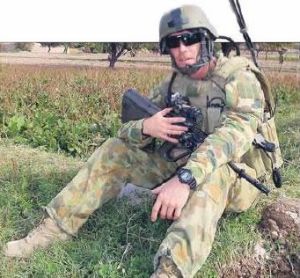
You might learn about an unknown soldier like Troy Methorst who had planned to leave the Army before a deployment but couldn’t let his mates take the risk alone and instead led his team of Combat Engineers for almost ten months of constant IED sweeps, vehicle and foot patrols. You might learn about how Troy, frustrated by the decisions of those behind safe desks as he led soldiers through the battlefield, left the Army on return to Australia and without the accountability of his mates, his brothers, fell into a spiral of drug and alcohol abuse. He would scan suburban roads for IEDs, assess every area for a danger that existed only in his memories. You’d learn how he recovered through connecting with old passions like sport and surfing, rebuilt, found love and life, and now helps others find themselves and their own health.
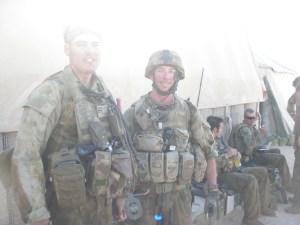
You can learn about an unknown soldier like Brendan Cannon, who came home on leave early in a tour for the birth of his first child, the joy and love of fatherhood tempered by the knowledge of his mates being injured and an Afghan soldier killed in an IED blast. After his return to Afghanistan, in the still of a night after a massive contact against the evil Taliban he wrote to his newborn son – a baby who he had barely had a chance to hold – and told him about all of the things he dreamed of doing with him one day, of the type of Dad he wanted to be. He wrote about those things just in case he never made it home alive. You’d learn how ‘Canno’ did make it home, and tries to live up to the promises of that letter still in even the toughest of times.
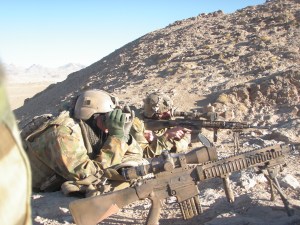
You could learn of the story of unknown soldiers like Marc Danieletto and his sniper team, who spent days alone behind enemy lines, watching and gathering intelligence for a coming battle. Of how they entered and extracted the battlefield at night, hoping that their feet did not find the trigger of a mine, that the bleat of a goat or the wanderings of a shepherd did not betray their position in the long days that followed. You might learn about how they returned to base unharmed, undetected, notebooks full of vital information that would save the lives of their fellow soldiers and the civilians they served with.
You might learn of the story of Billo, a young ASLAV Vehicle Commander who, as he watched a Bushmaster founder in a swollen river and almost swamp the soldiers strapped inside, directed his own vehicle to enter the raging waters to prop it up. Saving lives but sinking his own vehicle in the process. You might learn about the type of leader who would do that, and the soldiers who followed his direction without hesitation to save their brothers.
You might learn of how that lesson went unheeded one cold winters night and an American vehicle rolled over in that same river, trapping the crew inside. How Australian and American soldiers threw themselves into the cold black and crushing waters in a desperate effort to save the five soldiers within. Pulled from the torrent below the vehicle by their Afghan comrades as they couldn’t quite reach it time and time again. You might learn that it was two Aussies, Dave Neal and Robbie Rookley, with the American Commander, Nick Clemente, who finally made it to the overturned truck, almost drowning in the process themselves; and how managed to save one soul. Our history books do not like to speak of such things, of valiant failure brought on by errors, but this was an action requiring the highest of bravery.
You might learn the story of unknown soldier like Erica Van Ash, a nursing officer serving in Tarin Kowt who was so often the friendly face, the gentle touch and the kind word that our injured soldiers saw first as they arrived at the hospital with shattered limb and broken body. And for some, the last they ever felt or heard on this earth. You might learn about Erica and her team working in pools of blood as they desperately fought to save the life of Andrew Jones, who was gunned down by a traitorous Afghan soldier. Or how when that battle was over, Erica cleaned the blood away herself to save her younger team members that horror.
You might learn about an unknown soldier like Gordon Parker, veteran of Timor, the Solomons and Afghanistan, who had one high school mate step on a mine, lost another comrade in a rocket strike, who felt horrendously helpless and guilty that he couldn’t help Jonesy – because cooks are always meant to be safe. You might learn of how it wasn’t until his Mum could connect with him in person that Gordo could understand his own frustrations and learn to rise again. He still serves us as a Police Officer.
These unknown soldiers are from everywhere. And they are everywhere. Many will wear their medals with pride. Others only with a difficulty born of trauma. Some not at all. They will stand among us at the city squares and shrines, at those small country town roundabouts, on the hill tops and streets. They cannot forget. They will remember their mates. And the ghosts of those old Diggers will stand beside them, and they are proud.
So maybe on that hallowed ground, on that Anzac Day, wherever you are, you can ask one of those young veterans about their stories and if they are willing to share. They may not be easy to tell, and they may be as hard to hear, but they should belong to all of us.
Let them be known.
#NAFT
 Tales Of A No One Soldier.