I feel compelled to write this – at some risk of histrionic reaction and ensuing personal attack – because I have seen a number of friends and connections comment on this rather wretched piece of self-indulgent, inaccurate writing as if it was a logical and evidence driven position.
It is not.
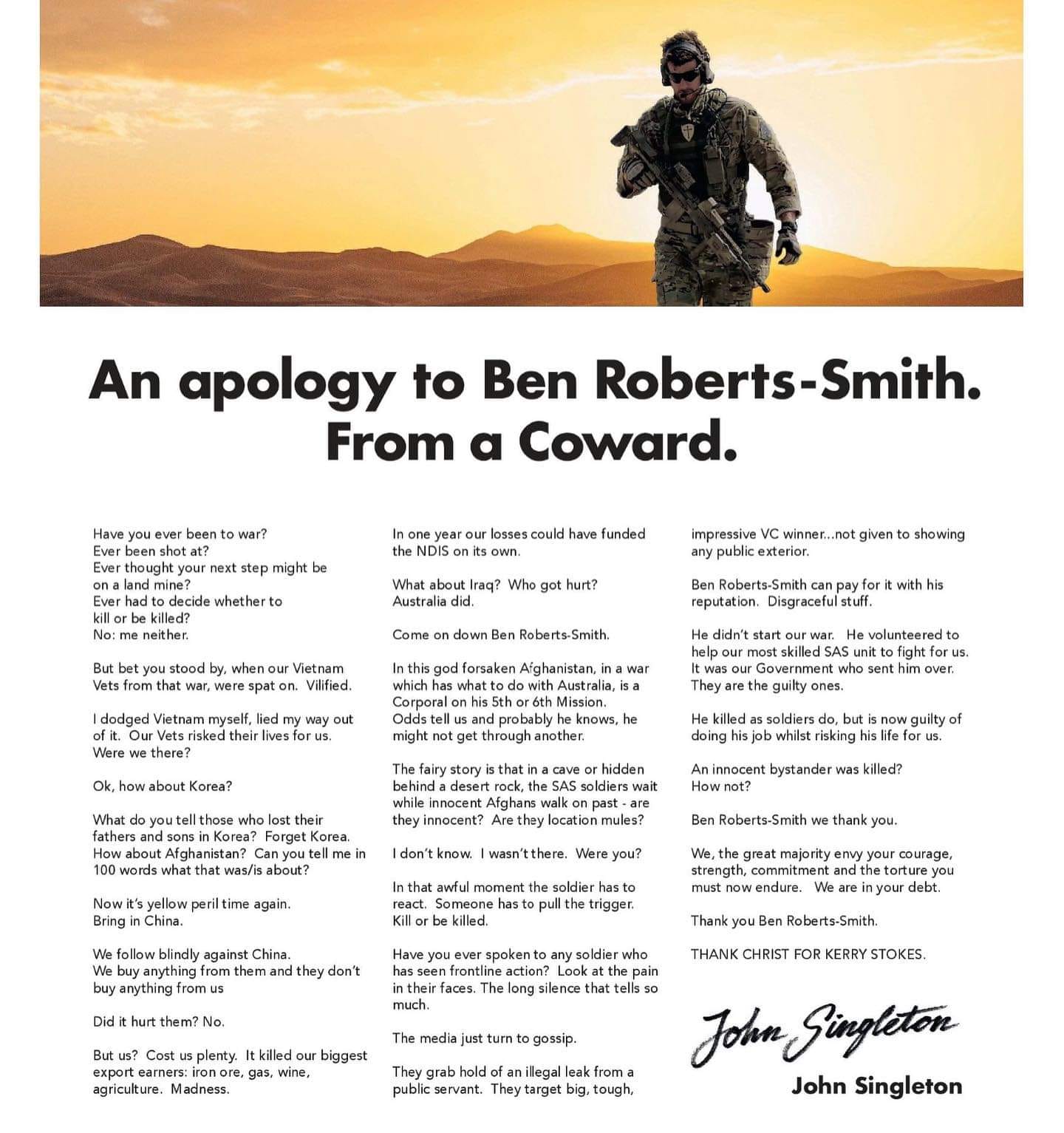
To answer Mr Singleton’s questions, I have been to war – more than once but not as many as others – I’ve been shot at, rocketed, feared IEDs, witnessed their effects, buried allies and enemies. I was ‘there.’ I understand the issues of not knowing who is friend or enemy from one day to the next, of sending my soldiers into harms way in spite of that knowledge, and knowing that they would not all come home the same.
War is a terrible human condition that makes us do inhumane things. But killing prisoners, non-combatants, is not one of those things it should make us do, regardless of the circumstances, and here Mr Singleton misses the point completely.
The accusations of war crimes against Australian soldiers from our Special Forces are explicitly NOT about instances in the heat of battle that Mr Singleton is at some pains to draw attention to, but of the cold blooded execution of prisoners and people who were detained for one reason or another. Even a cursory glance at the Brereton Report would see this is the case.
The Brereton Report, regardless of what you think of the length of time it took, or anything else, states that ‘credible information existed of 23 incidents in which one or more non-combatants or persons hoers-de-combat were unlawfully killed by or at the direction of Australian Special Forces in circumstances which, if accepted by a jury, would be the war crime of murder’ and further states that these acts were ‘not incidents of disputable decisions made under pressure in the heat of battle.’
No amount of bluster or admissions of cowardice by some old millionaire can change that. The facts are still being determined, but the evidence, provided in almost all cases by other members of the Special Forces, is worrying, damning and compelling.
I can understand the hurt and gut-reaction to reject out of hand these accusations against our Special Forces. These were warriors who were esteemed within the ADF. We looked up to them and envied their martial competence, bravery and the opportunities they had. These accusations, and the fact they are against those who were meant to be the best of us, hurt. I am hurt by them.
But that doesn’t make them untrue or worthy of such easy dismissal just because we would hate for them to real. It would not be the first time our heroes have disappointed us – take this from a previously fervent follower of Lance Armstrong.
I am also a strong believer that the Brereton Report all too easily dismisses the role and acts of omission from Special Operations and Defence leaders that enabled a culture where this could even be remotely possible and acceptable. And I do not just refer to the current ADF leadership but those who were in the Special Operations Command for the decades prior. They should also be held to account for those failures; some of these men are my friends, colleagues, people who would NEVER have accepted such actions had they known of them. And yet it seems they have occurred. How else would would there be video of an Australian Special Forces soldier shooting an unarmed Afghan man who was lying on his back in a field? This evidence seems to be forgotten by Mr Singleton and many others.
The point of this – if there is one – is that we can not simply dismiss these allegations because we don’t want them to be true. We can’t simply take out a full page ad in a newspaper because we have the means to and make it go away and speak on behalf of an alleged ‘great majority’.
We can not judge all of the Special Forces soldiers and officers by the actions of the few, but we must understand they existed in the same bubble. We must know that the actions of bravery that resulted in Roberts-Smith being awarded a Victoria Cross are different from those where he is accused of unlawful killings. But neither invalidates the other.
Mr Singleton is a coward by his own admission and I question the timing of his missive as a Judge is about to make a determination on the (I think) longest running defamation case in Australia, brought on by Roberts-Smith and lost by him. What are his real motivations and has he put his money where his poorly phrased mouth is?
Disagree and come at me if you will. But if you haven’t read the Report, critically thought about the possibilities and your argument amounts to “Nuh-uh because ANZAC and VC and ‘you weren’t there man’ and stuff” prepare for my response to be a lot less balanced and polite.
We owe it to ourselves as veterans, to our country as our supporters, and to our kids as the next generation to think deeply about this and accept all of the realities as uncomfortable as they may be.
These accusations and failures hurt us all. Pretending they don’t exist because a millionaire coward said so will hurt us tenfold times worse.


Thank you for adding your voice in response to the open ‘apology’ by John Singleton. Your response was well informed and balanced, and represents the views of the those with knowledge of the Brereton report and the need to hold people to account where there is evidence of illegal conduct
LikeLike
Thanks Rob.
Your point about there being a balanced account of the issues is the problem. Australian political and military leaders are trying to avoid any suggestion that they had any knowledge of mere allegations so resorted to pointing fingers. Australia has been fed a one sided narrative, and those with differing experiences are shut down. Why? To keep the leadership out of the ICC. I’m not saying any of the allegations are true or they are not. But if there wasn’t any concern about our rules of engagement why in mid 2013 did Hurley change them? By that stage it was irrelevant anyway as there were very few Missions being conducted. But the point remains. Whilst the task force was doing what was asked of us we were celebrated in Canberra. When it was Time to come home. Our missions weren’t as palatable. And they were sanctioned by govt kill capture missions. Unarmed individuals taking direct part or showing hostile intent were deemed by the ROE to be targetable. This roe was signed off. Prior to Sasr last recommitment. ADF Officers in the US embassy in Canberra told the us officials. If the SF deploy back to Afghan. Under ISAF, They can be more aggressive .
well they got what they wanted. They accepted the risk. They shouldn’t be allowed to shirk the responsibility.
LikeLike
Essentially,
My point is that posts like this do not help. The only one who gains from their publication is the publisher.
This whole investigation has been flawed from the start. From the collection of ‘evidence’ to the treatment of the soldiers and their families. The destruction of capabilities has been gratuitous and not done for a culture change. But to show the world ‘something has been done’ In doing so, the last decade of ill-informed attacks have ruined lives. It’s treatment akin to a bygone era. And an absolute disgrace.
As a reality check. In Australia. Those who rape and murder children are given anonymity until conviction. As Dave rightly pointed out, BRS lost a defamation case that he brought. However, what choice did he have but to start a civil suit? Heston Russell, well. He proved the lies the media are happy to put into print to sell a story, leaving his reputation in tatters after years of stress. But what choice did he have?
Besanko, the judge who sat in the case for nine months, returns with, “I accept BRS took the leg and drank out of it.” Even Fairfax said their defendant, person 6, took it, and BRS didn’t drink out of it.
Some of the witnesses against him needed immunity for what he said BRS was guilty of, But his character, according to Besanko, was trustworthy.
Nine months and Besanko still gets simple.
Details like that and the one-sided narrative make it difficult to see how anyone will get a fair trial. We’ve not seen unbiased treatment for ten years, so why expect it now?
The ADF, GOVT, IGADF, and OSI have proven incompetent to run such an investigation. I know I’m not alone, but I wish the ICC had heard the complaints. At least Soldier’s would’ve been given the presumption of innocence that those who refuse anything other than ‘moral responsibility’ so venomously deny them.
LikeLike
In response to your open letter, I feel compelled to address a fundamental question regarding your perspective on the Brereton ‘scoping report.’ You characterise it as credible and express complete agreement with its accusations. However, in the same context, you acknowledge the duplicity of those it absolved. How can you not even entertain doubts regarding the integrity of the report after such inconsistencies?
Having personally undergone the process, I want to shed light on the methods employed to extract information for the report. The legally binding signature ensures that anyone discussing the content of their interview face criminal prosecution. During the interviews. do you know tactics such as coercion, perfidy, and threats were used to elicit information? It not only casts doubt on the reliability of the information gathered but also raise serious ethical concerns about the IGADF methodology and is the exact reason the Office of Special Investigations (OSI) cannot utilise the information. If you knew this, would you have been a little more sceptical about the report’s findings? A report that absolves the writer’s boss, who, after his report, was gifted a new government role made just for him as a government watchdog… watching those who he had just absolved… for any criminality… seem legit?
Are you aware of the toxic rivalries that prompted specific individuals within SASR to discuss BRS? Did you notice this only occurred after he was awarded the commendation for distinguished service?
Additionally, are you aware that the main witness against BRS did not provide evidence in court because he served as the middleman between the IGADF and the media, which led to him being kept out of court at all costs?
Are you aware these men flouted the military complaints process, broke numerous laws by going directly to the media? Not once taking their claims to the military police ? Why? Not for allegations of warcrimes, but in order to bring down a personal enemy?
I read the letter they wrote in 2014; sigh ed by two of my mentors. they claimed it was reporting war crimes; well, I can tell you as a witness after reading it. This men that chose to hide in the shadows accused him of being a bully, and not once did they mention anything as severe as murder, or warcrimes.
Are you familiar with the Rules of Engagement (ROE) differences between the ADF and SOTG in Afghanistan? While it’s true that SOTG ROE did not permit extrajudicial killing, and rightly so, our RoE differed significantly from your RoE. However, I doubt you have a complete understanding of the intricacies of Rule 429 A/B, or the terms ‘direct part in hostilities, or hostile intent, hostile act’, because the SOTG lawyers who were tasked with imparting this wisdom weren’t even entirely across it.
I’d also like to point out, the principle of innocent until proven guilty in Australia. You mentioned a JPEL as “an Unarmed Afghan man in a field.” Were you equipped with x-ray glasses in 5 RAR, allowing you to see through knee-high grass? You claimed to have ‘dodged IEDs’, but were you briefed on the existence of body bombs and their size? Did the individual in question possess one or a belt of explosives, maybe? Having served in SASR for 15 years, I couldn’t see through the grass to discern such intimate details. And incidentally, Singleton did not mention Soldier C; he referenced BRS.
I also am deeply hurt. Hurt that individuals who dedicated their lives to SASR and ADF were dismissed without due judicial process, not just the accused. I am Hurt that the families who endured the separation of repeated deployments and anxiously awaited the safe return of their loved ones, have had to bear the brunt of this public decade-long investigation, with many having their homes searched and vehicles searched. It Hurts me that our military and political leaders stood before the world and absolved themselves of any wrongdoing except for moral responsibility, which, in my honest opinion, is utterly irrelevant, and in the same breath blamed those who carried the lion’s share of deployments, without judicial process, and based on a report whose author states, he doesn’t have the remit to find any wrongdoings. And I’m hurt by the diatribe from the media that has incorrectly reported the facts from day one.
But above all, I am deeply hurt by individuals like you. Just as opinions vary, so do experiences. I can assure you that your Afghan experience differed significantly from that of every SASR soldier and CDO who ventured outside the wire. I can assure you that the intelligence we received was drastically different, and I can assure you that SAS missions, conducted in direct support of you in MTF, aimed to neutralise the insurgent threat, Those men like the bombmaker killed in the field in Urusghan, and had the SOTG not been so offensive, I can also assure you that the number of Australians KIA would be much higher.
I welcome the sentiment expressed in John Singleton’s letter. Regardless if he missed one point or ten. The media lies endorsed by the establishment for the last ten years have outweighed any input this letter has had.
Thank god for Men like Kerry Stokes and John Singleton.
LikeLike
Thanks for the above. I am travelling for the next couple of days and will reply after that. Appreciate the time you have taken to write.
LikeLike
I was not there, as i retired in 1997 after 17 years in Infantry & Signals. My hat goes off to ALL Australians who serve & served even ONE tour, let alone numerous. I di 13 months in Cambodia in Peacekeeping, NOTHING near what you ALL went through. But i like MANY Ex members are highly upset/pissed off as to ADF Command’s attitude and the way they have washed their hands of ANY INCIDENT/S.
As for those back home in armchairs, well i have nothing BUT CONTEMPT for them. As the above and many others states SASR & CDO did it a lot harder and longer and had different ROE’s. Brereton report? No i have not read, and most likely will never read it as i have no doubt it is full of BS. How long has it been out now??? what action has been done from it????? what action is being done from it???? Have the number/s of supposed KIA in captivity been confirmed or is it a figure plucked from air????
The two reporters who have written books on BRS and his actions well we all know that SCUMM does not rise very far. We as a Nation and as a society as a whole leave a lot to be desire when we continue to harrass, tear apart, and destroy those who put themselves on the frontline to SERVE the Nation and protect its civilians, then to have those try and back away from Command Authority is just AMAZING. I stand by BRS.
LikeLike
If there are allegations. They should be tested. But fairly. Not on “information” gained illegally, and those accused should most certainly not be judged by lame stream media, and those attempting to further their career but in a court. What we have eeen unfold over ten years is un Australian.
Critics are men who watch a battle from a high place then come down and shoot the survivors.~ Ernest Hemingway thanks for the support mate
LikeLike
I’ll post this here, Just in case Sparky decides not to approve it.
Sparky. I know a bar in an office in Canberra called that. Confidence? I think not.
I want to clarify that I never considered myself exceptional or special, and most SASR operators I worked with shared the same perspective. We were selected and trained to carry out ‘special’ missions at the government’s request. Whether the role of kill-capture missions was truly special is neither here nor there. However, did individuals who made it through the selection process possess a different mindset from me and those I worked with? And did some later represent SASR in areas where they probably shouldn’t? Yes, undoubtedly, but with few men to choose from and SQNs deploying each year for close to fourteen years, the pool of men to choose from was limited and was a reality in every like-minded FVEY SOF unit. Still, the same can be said about people from your Organisation. I witnessed first-hand the misconduct that led to many of your colleagues losing their jobs following the Afghan debacle. Oddly, these people and their acts were not those I would attribute to the type of officer who should work in your organisation, especially when tasked to conduct discreet, highly sensitive operations for Australia. Your assertion that your organisation worked closely with SFOD-D is highly dubious. Having been seconded to them, I know first-hand how selective they are about who they allow into their inner circle—especially foreign organisations like yours. You may have had a drink in your bar as they passed through, but to claim a deeper level of collaboration is highly improbable.
My point is this: while your experiences with a few SASR operators drive your attack against the ‘SASR individual culture’—culture is driven from the top, by the way, not by the person or sub-unit—SASR is no exception to other like-minded FVEY SOF units, or yours, for that matter. No selection process is infallible; whilst it may get it right 98% of the time, some individuals slip through the cracks at both ends of the bell curve and should be rooted out for various reasons. What sets Australia apart from FVEY SOF—units like the one you mention reverently, who are also facing similar allegations, I might add—is the length of time our soldiers are allowed to serve, therefore deploy repeatedly on operations, and our national pastime of cutting down the perceived ‘tall poppies’. This post and your attack on the Afghan epoch SAS Regiment, due to your negative experience, is an example of the latter. I know many in Canberra who had differing experiences from yours.
Regarding your comments about having the intelligence and humility to accept the Brereton report as to the allegations, what you termed “obviously occurred,” and us “growing from this failure,” well, I went through the process as a witness; I saw the lengths the interviewers went to as they targeted individuals and the way the information was gathered. So, no. I have no faith in the information presented, and it’s crucial to note. Brereton labelled it ‘information,’ not what you refer to as ‘overwhelming evidence and exhaustive judicial process. Knowing how your organisation works on intelligence, I thought you should be able to tell the difference. Yes, the process was/is exhaustive, but not in the sense you mean and judicial! Not so much. Since the allegations aired, I have refrained from judging the veracity of claims against anyone, instead leaving it for a jury; I merely stated that Ben Roberts Smith and Heston Russell were left with little choice to defend their names in court, and in doing so, Heston Illustrated the inaccuracies propagated by the media, and during the BRS v Fairfax trial, light was shed on the hypocrisy of those pointing the finger at Ben Roberts-Smith for needing immunity for the same actions they accuse him of.
Interestingly, some of those SASR operators who spoke against him were the same whistle-blowers who worked with your organisation. Knowing where you work, I hope your comments aren’t indicative of support for them. They divulged classified information to journalists, broke military laws, and needed immunity for allegations of their war crimes; if your comments were supportive, they would be concerning and contradictory. Nothing is so hypocritical as breaking the rules in the guise of protecting them. Perhaps after noting the content of your comments, I should forward a copy to the relevant authorities.
While it remains to be seen if the criticism you mentioned is justified, it’s worth noting that SASR has faced criticism before. Just as Afghanistan-era veterans were moved on, SASR members also experienced similar circumstances after the Vietnam War. While turnover is a natural part of any organisation and can facilitate renewal and growth, handling such situations with care is crucial. If the goal is to replace an old bridge, it’s prudent to build a new one first. Regrettably, the approach taken by ADF leadership had significant repercussions on the mental well-being of veterans and their families. The callous treatment of those who bore the brunt of the fighting over the past two decades, not only in Afghanistan but elsewhere as well, had a detrimental impact on SASR as a unit, as well as on the individuals and their families selected or posted to SASR.
The newer generation of SASR operators, trained by Afghan-era veterans, have evolved. As we learned from our predecessors, they learned from our successes and mistakes. They also learned lessons from our treatment. However, if you believe they are fundamentally different from those selected, trained and deployed during the “GWOT” due to public shaming and an ethics campus course, you’re sorely mistaken. And despite your welcoming them as a breath of fresh air, these men witnessed how your organisation turned on itself and ate its young; they saw how SASR members were blamed for some of your organisation’s indiscretions and how you kept notes on those of us who worked with you. Simply put, they don’t trust you.
This lack of trust extends to ADF leadership, which side-lined those who sought to be part of the positive change at SASR and SOCOMD. Unfortunately, those leaders preferred a scorched-earth method over a collaborative approach, which eroded the new generation’s confidence in SOCOMD and your organisation. Regardless, the question was never could the soldiers could change but whether the leaders could. Unfortunately, events since Afghanistan suggest they cannot.
I agree with your assertion that recognition for exceptionalism comes from exceptional work, not from the hat one wears, and many within SAS, then and now, would share the sentiment. However, I disagree with your suggestion that “many inside SASR thought it was about the hat or the colour of it.” Disregarding the fact that for the first eight years of my career, I can count on one hand the number of times, I wore the Sandy beret, for me and many others, being part of SASR represented much more than just ‘a symbol’; it embodied service, shared goals and values, mutual trust among teammates, and a sense of belonging to a family. It was about making a meaningful difference in the world. However, I can understand if you find it difficult to comprehend some of these sentiments, understanding the organisation you come from, which values individualistic tendencies over teamwork, especially considering the poor teamwork that was witnessed within your organisation during the repercussions you experienced post your Afghanistan experience, the toxic climate of backstabbing that emerged with individuals resorting to letter-writing about other officers to safeguard their positions wasn’t special at all. So, in response to the gradual decline and near loss of the ‘truly quiet professionals.’ I’ll just remind you of the phrase about people in glass houses and leave it at that. However, in saying that, I know many individuals within SASR and your organisation who are truly quiet professionals, and the fact that so many from my unit, after serving multiple deployments to Afghanistan, eventually joined yours is evidence of this and of the SASR culture I’m referring to.
Unlike you, I won’t disparage your organisation or its role, and I’ll refrain from passing judgment on your colleagues based on a report that deemed them to have fostered a frontier culture unworthy of your organisation. I have faith in your organisation and count friends within it, both of which I consider truly worthy. Just as SASR’s role is unique and imperative to Australia’s national security, your role holds even more significance, especially today. As such, I sincerely hope that the fractures in your organisation’s culture and the sad individual rottenness following your post-Afghanistan fallout have taught you valuable lessons and that your organisation and its individuals have grown from your failures. Australia relies on your vital contributions; events in Sydney today proved that much.
Even though I’m disgusted with successive governments, I, too, have a solid patriotic love for my country; however, in your rush to ‘have a rant’ and need to inform about your patience, you seemed to overlook the essence of my comments on Dave F’s post. My remarks emphasised the importance of forming judgments based on evidence rather than dodgy information sold incorrectly by CDF and referred to by you as evidence. I pointed out how soldiers have been deemed guilty based on, in some cases, eighteen-year-old allegations without due process. Furthermore, I highlighted the hypocrisy of individuals who proudly display numerous honours and awards for their wartime leadership, some illegally, yet fail to acknowledge their failures, which the report ultimately absolves.
I firmly believe in upholding the principle of granting individuals the presumption of innocence until proven guilty without exception. This holds especially true for those who served their country in a war marked by a lack of strategy, poor leadership and intelligence, and inadequate resources. Despite the West’s failure to implement democracy in the Middle East, those who fought to promote it there deserve the rights, values and fair treatment that democracy purports to offer. Given your involvement in upholding our laws, surely you’re familiar with the word “accused”? As last time I checked, no one has been convicted of any crime, so how can you, with your knowledge of the law, label these men as murderers and war criminals? After all, we still live in a democratic society,
I’m genuinely sorry your experiences with the SASR operators you encountered weren’t great. I loved serving within the Regiment, and if reported, those who were poor ambassadors for it should’ve been held accountable. That said, your comments hold extreme negative bias, lack humility and self-awareness and appear to be made against a whole generation of SASR operators, not just the few who offended you but an entire regiment of men who dedicated decades to ADF and Australia, simply because of your past experiences, which appear to have profoundly influenced your perspective, making you unwilling to offer even the most basic fairness to those accused. This closed-mindedness makes engaging in meaningful conversation with you further as pointless as the war in Afghanistan.
Your expression of gratitude for my service isn’t necessary. My colleagues and I considered serving in SASR as a privilege, and reading your message in its entirety, your gesture appears insincere. As for enjoying retirement, I doubt many SASR Afghan veterans have that luxury, given the constant media diatribe, webpages like Dave’s, and Ill-informed comments like yours that lack the very same self-awareness and humility you accuse others of not possessing.
Regardless of your opinion on Mr. Singleton, I appreciate his sentiment. It indicates that Australians are becoming increasingly aware of the double standards employed by those who hold the ‘talking stick’ and are growing weary of their bullshit and the hypocrisy they perpetuate.
LikeLike
Ex-MRTF here. Alright, let’s dig into this. So, I get that you’re pretty fired up about the whole Brereton report situation, but I’ve got to say, some of your arguments are raising a few red flags for me.
First off, questioning the credibility of the report because of inconsistencies is fair game, but then you start going off about coercion and threats during interviews? That’s a pretty serious accusation to throw around without concrete evidence. And if those tactics were really used, why hasn’t there been more noise about it? Seems like something that big wouldn’t stay under wraps for long.
And let’s not forget the elephant in the room here: the accusations of war crimes. Brushing them off as just personal vendettas or office politics doesn’t sit right with me. These are serious allegations that deserve a thorough investigation, regardless of who’s involved. Didn’t we obviously get that? You have to face facts lol.
Sure, the media might not always get their facts straight, but that doesn’t mean we should just dismiss everything they say. And as for Kerry Stokes and John Singleton, yeah, they might be speaking out, but they’re not exactly impartial observers either.
Look, I’m not saying the Brereton report is flawless. Probably far from it. But jumping to conclusions and throwing around accusations left and right isn’t helping anyone, particularly when you say you haven’t read it… Obviously somethign spectacular when wrong with SF, and the arrogance and “shut up you weren’t there” doesn’t hold water with us from the battlegroup side of things. We’re not stupid either.
LikeLike
To 353, as someone who has spent much time working with your professional brothers in arms from the civilian side of your more quiet work, the gradual decline and near loss of the true quite professional is the biggest issue many have with the Special Air Service Regiment, and one that seems to be an awful blind spot no matter what external eyes are looking in at you. I met the absolute best and worst of Australians who were wearing your beret, and was astounded at times that your own unit had selected some people who frankly fell far short of of the kind of representatives we thought to be our nation’s best warriors. Oddly these people were the loudest and most clumsy when interferring with long running and highly sensitive operations we were involved in.
The sad rotteness of Australian special forces individual culture has been obvious to many government people for years now, but even with the public release of the Brereton report, and the failed defamation trial of Ben Roberts-Smith, it is astounding that so many lack the intelligence and humility to accept what obviously occurred and grow from this failure. That so many can’t, makes clear the expulsion of certain individuals was in the best interest of the new generation of Australian special forces soldiers, of whom we’ve already seen (when working in proximity to us) are striving hard to return to the humble and excellent professional that are the origins of respect for the pre-GWOT Special Air Service Regiment.
Recognition for exceptionalism comes from exceptional work, and not the hat you wear on your head. This seems to elude many inside the Special Air Service Regiment, and I would contrast your unit directly with American members of the 1st SFOD community, and other civilian paramilitary groups I won’t name here, who are humble and professional in ways which too many Australian special forces operators are not. Why is this the case? We all have our theories, but already the next generation of Special Air Service Regiment soldiers are a welcomed breath of fresh air to us.
The return of the true quiet professional.
Perhaps your natural reaction to this commentary is to reduce what you know my role to be as unworthy of your special status and excellene. The ‘babysitters’ in our own unit aren’t afforded much respect, but I sense this is a wider reflection of a shattered culture that is now being justly criticised for the first time in your history. For all this potential hatred of me as the other, let me acknowledge the war fighting side of the Special Air Service Regiment’s role in Afghanistan, and that I personally don’t know what the everyday 353 operator went through. I have respect for the mission you prosecuted in Afghanistan, and extreme jingoistic patience for those of you who did the right thing; but don’t mistake this patience for an excuse to hide your murderes and war criminals. I love Australia more, and the damage that the Special Air Service Regiment has done to my country’s reputation in the eyes of thinking and knowing people (and not cowardly billionaire’s who have not truly served their country) is nearly unforgiveable.
You are fighting a lost cause here. And you are convincing NO ONE of the Special Air Service’s untouchable greatness in the face of overwhelming evidence and exhaustive judicial process.
Thank you for your service, and enjoy your retirement.
LikeLike
Sparky. I know a bar in an office in Canberra called that. Confidence? I think not.
I want to clarify that I never considered myself exceptional or special, and most SASR operators I worked with shared the same perspective. We were selected and trained to carry out ‘special’ missions at the government’s request. Whether the role of kill-capture missions was truly special is neither here nor there. However, did individuals who made it through the selection process possess a different mindset from me and those I worked with? And did some later represent SASR in areas where they probably shouldn’t? Yes, undoubtedly, but with few men to choose from and SQNs deploying each year for close to fourteen years, the pool of men to choose from was limited and was a reality in every like-minded FVEY SOF unit. Still, the same can be said about people from your Organisation. I witnessed first-hand the misconduct that led to many of your colleagues losing their jobs following the Afghan debacle. Oddly, these people and their acts were not those I would attribute to the type of officer who should work in your organisation, especially when tasked to conduct discreet, highly sensitive operations for Australia. Your assertion that your organisation worked closely with SFOD-D is highly dubious. Having been seconded to them, I know firsthand how selective they are about who they allow into their inner circle—especially foreign organisations like yours. You may have had a drink in your bar as they passed through, but to claim a deeper level of collaboration seems improbable.
My point is this: while your experiences with a few SASR operators drive your attack against the ‘SASR individual culture’—culture is driven from the top, by the way, not by the person or sub-unit—SASR is no exception to other like-minded FVEY SOF units, or yours, for that matter. No selection process is infallible; whilst it may get it right 98% of the time, some individuals slip through the cracks at both ends of the bell curve and should be rooted out for various reasons. What sets Australia apart from FVEY SOF—units like the one you mention reverently, who are also facing similar allegations, I might add—is the length of time our soldiers are allowed to serve, therefore deploy repeatedly on operations, and the national pastime of cutting down the perceived ‘tall poppies’. This post and your attack on the Afghan epoch SAS Regiment, due to your negative experience, is an example of the latter. I know many in Canberra who had differing experiences from yours.
Regarding your comments about having the intelligence and humility to accept the Brereton report as to allegations, what you termed “obviously occurred,” and us “growing from this failure,” I went through the process as a witness; I saw the lengths they targeted individuals and the way the information was gathered. So, no. I have no faith in the information presented, and it’s crucial to note. Brereton labelled it ‘information,’ not what you refer to as ‘overwhelming evidence and exhaustive judicial process. Knowing how your organisation works on intelligence, I thought you should be able to tell the difference. Yes, the process was/is exhaustive, but not in the sense you mean judicial…. not so much. Since the allegations aired, I have refrained from judging the veracity of claims against anyone, instead leaving it for a jury; I merely stated that Ben Roberts Smith and Heston Russell were left with little choice to defend their names in court, and in doing so, Heston Illustrated the inaccuracies propagated by the media, and during the BRS v Fairfax trial, light was shed on the hypocrisy of those pointing the finger at Ben Roberts-Smith for needing immunity for actions they accuse him of.
Interestingly, some of those SASR operators who spoke against him were the same whistle-blowers who worked with your organisation. Knowing where you work, I hope your comments aren’t indicative of support for them. They divulged classified information to journalists, broke military laws, and needed immunity for allegations of their war crimes; if your comments were supportive, they would be concerning and contradictory. Nothing is so hypocritical as breaking the rules in the guise of protecting them. Perhaps after noting the content of your comments, I should forward a copy to the relevant authorities.
While it remains to be seen if the criticism you mentioned is justified, it’s worth noting that SASR has faced criticism before. Just as Afghanistan-era veterans were moved on, SASR members also experienced similar circumstances after the Vietnam War. While turnover is a natural part of any organisation and can facilitate renewal and growth, handling such situations with care is crucial. If the goal is to replace an old bridge, it’s prudent to build a new one first. Regrettably, the approach taken by ADF leadership had significant repercussions on the mental well-being of veterans and their families. The callous treatment of those who bore the brunt of the fighting over the past two decades, not only in Afghanistan but elsewhere as well, had a detrimental impact on SASR as a unit, as well as on the individuals and their families selected or posted to SASR.
The newer generation of SASR operators, trained by Afghan-era veterans, have evolved. We learned from our predecessors, as they learned from our successes and mistakes. They also learned lessons from our treatment. Still, if you believe they are fundamentally different from those selected and trained during the “GWOT” due to public shaming and an ethics campus course, you’re sorely mistaken. And despite your welcoming them as a breath of fresh air, these men witnessed how your organisation turned on itself and ate its young. They saw how SASR members were blamed for some of your organisation’s indiscretions and how you kept notes on those of us who worked with you.
Simply put, they don’t trust you. This lack of trust extends to ADF leadership, which side-lined those who sought to be part of the positive change at SASR and SOCOMD. Unfortunately, those leaders preferred a scorched-earth method over a collaborative approach, and the treatment eroded their confidence in both SOCOMD and your organisation. Regardless, the question was never if the soldiers could change but whether the leaders could. Unfortunately, events since Afghanistan suggest they cannot.
I agree with your assertion that recognition for exceptionalism comes from exceptional work, not from the hat one wears, and many within SAS, then and now, would share the sentiment. However, I disagree with your suggestion that “many inside SASR thought it was about the hat or the colour of it.” Disregarding the fact that for the first eight years of my career, I can count on one hand the number of times, I wore the Sandy beret, for me and many others, being part of SASR represented much more than just ‘a symbol’; it embodied service, shared goals and values, mutual trust among teammates, and a sense of belonging to a family. It was about making a meaningful difference in the world. However, I can understand if you find it difficult to comprehend some of these sentiments, understanding the organisation you come from, which values individualistic tendencies over teamwork, especially considering the poor teamwork witnessed within your organisation as witnessed after the repercussions of your post-Afghanistan experiences, and the toxic climate of backstabbing that emerged within your organisation, with individuals resorting to letter-writing about other officers to safeguard their positions. So, in response to the gradual decline and near loss of the ‘truly quiet professionals.’ I’ll just remind you of the phrase about people in glass houses and leave it at that. However, in saying that, I know many individuals within SASR and your organisation who are truly quiet professionals, and the fact that so many from my unit, after serving multiple deployments to Afghanistan, eventually joined yours is evidence of this and the SASR culture I’m talking about.
Unlike you, I won’t disparage your organisation or its role, and I’ll refrain from passing judgment on your colleagues based on a report that deemed them to have fostered a frontier culture unworthy of your organisation. I have faith in your organisation and count friends within it, both of which I consider truly worthy. Just as SASR’s role is unique and imperative to Australia’s national security, your role holds even more significance today. As such, I sincerely hope that the fractures in your organisation’s culture and the sad individual rottenness following your post-Afghanistan fallout have taught you valuable lessons and that your organisation and its individuals have grown from your failures. Australia relies on your vital contributions; events in Sydney today proved that much.
Even though I’m disgusted with successive governments, I, too, have a solid patriotic love for my country; however, in your rush to ‘have a rant’, you seemed to overlook the essence of my comments on Dave F’s post. My remarks emphasised the importance of forming judgments based on evidence rather than dodgy information sold incorrectly by CDF as evidence. I pointed out how soldiers have been deemed guilty based on, in some cases, eighteen-year-old allegations without due process. Furthermore, I highlighted the hypocrisy of individuals who proudly display numerous honours and awards for their wartime leadership, some illegally, yet fail to acknowledge their failures, which the report ultimately absolves.
I firmly believe in upholding the principle of granting individuals the presumption of innocence until proven guilty without exception. This holds especially true for those who served their country in a war marked by a lack of strategy, poor leadership, and inadequate resources. Despite the West’s failure to implement democracy in the Middle East, those who fought to promote it there deserve the rights, values and fair treatment that democracy purports to offer. Given your involvement in upholding our laws, surely you’re familiar with the word “accused”? As last time I checked, no one has been convicted of any crime, so how can you, with your knowledge of the law, label these men as murderers and war criminals? After all, we still live in a democratic society,
I’m genuinely sorry your experiences with the SASR operators you encountered weren’t great. I loved serving within the Regiment, and if reported, those who were poor ambassadors for it should’ve been held accountable. That said, your comments hold extreme negative bias and appear to be against a whole generation of SASR operators, not just the few, but an entire regiment of men who dedicated decades to ADF and Australia, simply because of your experiences. Your past experiences have deeply influenced your perspective, making you unwilling to offer even the most basic fairness to those accused. This closed-mindedness makes engaging in meaningful conversation with you further as pointless as the war in Afghanistan.
Regardless of your take on Mr Singleton, I welcome his sentiment. It shows Australians can see the double standard approach of those who hold the ‘talking stick’ and are getting sick and tired of their bullshit.
Your gratitude is appreciated, but I don’t require thanks for my service; Like serving in SASR, I considered it a privilege. Although reading your words in full, your gesture seems more like a false compliment. As for enjoying retirement, I doubt many SASR Afghan veterans have that luxury, given the media diatribe and blogs like Dave’s, making ill-informed comments.
LikeLike
Sparky. I know a bar in an office in Canberra called that. Coincidence? I think not.
I want to clarify that I never considered myself exceptional or special, and most SASR operators I worked with shared the same perspective. We were selected and trained to carry out ‘special’ missions at the government’s request. Whether the role of kill-capture missions was truly special is neither here nor there. However, did individuals who made it through the selection process possess a different mindset from me and those I worked with? And did some later represent SASR in areas where they probably shouldn’t? Yes, undoubtedly, but with few men to choose from and SQNs deploying each year for close to fourteen years, the pool of men to choose from was limited and was a reality in every like-minded FVEY SOF unit. Still, the same can be said about people from your Organisation. I witnessed first-hand the misconduct that led to many of your colleagues losing their jobs following the Afghan debacle. Oddly, these people and their acts were not those I would attribute to the type of officer who should work in your organisation, especially when tasked to conduct discreet, highly sensitive operations for Australia. Your assertion that your organisation worked closely with SFOD-D is highly dubious. Having been seconded to them, I know first-hand how selective they are about who they allow into their inner circle—especially foreign organisations like yours. You may have had a drink in your bar as they passed through, but to claim a deeper level of collaboration is highly improbable.
My point is this: while your experiences with a few SASR operators drive your attack against the ‘SASR individual culture’—culture is driven from the top, by the way, not by the person or sub-unit—SASR is no exception to other like-minded FVEY SOF units, or yours, for that matter. No selection process is infallible; whilst it may get it right 98% of the time, some individuals slip through the cracks at both ends of the bell curve and should be rooted out for various reasons. What sets Australia apart from FVEY SOF—units like the one you mention reverently, who are also facing similar allegations, I might add—is the length of time our soldiers are allowed to serve, therefore deploy repeatedly on operations, and our national pastime of cutting down the perceived ‘tall poppies’. This post and your attack on the Afghan epoch SAS Regiment, due to your negative experience, is an example of the latter. I know many in Canberra who had differing experiences from yours.
Regarding your comments about having the intelligence and humility to accept the Brereton report as to the allegations, what you termed “obviously occurred,” and us “growing from this failure,” well, I went through the process as a witness; I saw the lengths the interviewers went to as they targeted certain Individuals and the way in which they gathered information. So, no. I have no faith in the information presented, and it’s crucial to note. Brereton labelled it ‘information,’ not what you refer to as ‘overwhelming evidence and exhaustive judicial process. Knowing how your organisation works on “intelligence”, I thought you should be able to tell the difference. Yes, the process was/is exhaustive, but not in the sense you mean and judicial! Not so much. Since the allegations aired, I have refrained from judging the veracity of claims against anyone, instead leaving it for a jury; I merely stated that Ben Roberts Smith and Heston Russell were left with little choice to defend their names in court, and in doing so, Heston Illustrated the inaccuracies propagated by the media, and during the BRS v Fairfax trial, light was shed on the hypocrisy of those pointing the finger at Ben Roberts-Smith for needing immunity for the same actions they accuse him of.
Interestingly, some of those SASR operators who spoke against him were the same whistle-blowers who worked with your organisation. Knowing where you work, I hope your comments aren’t indicative of support for them. They divulged classified information to journalists, broke military laws, and needed immunity for allegations of their war crimes; if your comments were supportive, they would be concerning and contradictory. Nothing is so hypocritical as breaking the rules in the guise of protecting them. Perhaps after noting the content of your comments, I should forward a copy to the relevant authorities.
While it remains to be seen if the criticism you mentioned is justified, it’s worth noting that SASR has faced criticism before. Just as Afghanistan-era veterans were moved on, SASR members also experienced similar circumstances after the Vietnam War. While turnover is a natural part of any organisation and can facilitate renewal and growth, handling such situations with care is crucial. If the goal is to replace an old bridge, it’s prudent to build a new one first. Regrettably, the approach taken by ADF leadership had significant repercussions on the mental well-being of veterans and their families. The callous treatment of those who bore the brunt of the fighting over the past two decades, not only in Afghanistan but elsewhere as well, had a detrimental impact on SASR as a unit, as well as on the individuals and their families selected or posted there.
The newer generation of SASR operators, trained by Afghan-era veterans, have evolved. As we learned from our predecessors, they learned from our successes and mistakes. They also learned lessons from our treatment. However, if you believe they are fundamentally different from those selected, trained and deployed during the “GWOT” due to public shaming and an ethics campus course, you’re sorely mistaken. And despite your welcoming them as a breath of fresh air, these men witnessed how your organisation turned on itself and ate its young; they saw how SASR members were blamed for some of your organisation’s indiscretions and how you kept notes on those of us who worked with you. Simply put, they don’t trust you.
This lack of trust extends to ADF leadership, which side-lined those who sought to be part of the positive change at SASR and SOCOMD. Unfortunately, those leaders preferred a scorched-earth method over a collaborative approach, which eroded the new generation’s confidence in SOCOMD and organisations like yours. Regardless, the question was never “Could the soldiers change but whether the leaders could”. Unfortunately, events since Afghanistan suggest they cannot.
I agree with your assertion that recognition for exceptionalism comes from exceptional work, not from the hat one wears, and many within SAS, then and now, would share the sentiment. However, I disagree with your suggestion that “many inside SASR thought it was about the hat or the colour of it.” Disregarding the fact that for the first eight years of my career, I can count on one hand the number of times, I wore the Sandy beret, for me and many others, being part of SASR represented much more than just ‘a symbol’; it embodied service, shared goals and values, mutual trust among teammates, and a sense of belonging to a family. It was about making a meaningful difference in the world. However, I can understand if you find it difficult to comprehend some of these sentiments, understanding the organisation you come from, which values individualistic tendencies over teamwork, especially considering the poor teamwork that was witnessed within your organisation during the repercussions you experienced post your Afghanistan experience, the toxic climate of backstabbing that emerged with individuals resorting to letter-writing about other officers to safeguard their positions wasn’t special at all. So, in response to the gradual decline and near loss of the ‘truly quiet professionals.’ I’ll just remind you of the phrase about people in glass houses and leave it at that. However, in saying that, I know many individuals within SASR and your organisation who are truly quiet professionals, and the fact that so many from my unit, after serving multiple deployments to Afghanistan, eventually joined yours is evidence of this and of the SASR culture I’m referring to.
Unlike you, I won’t disparage your organisation or its role, and I’ll refrain from passing judgment on your colleagues based on a report that deemed them to have fostered a frontier culture unworthy of your organisation. I have faith in your organisation and count friends within it, both of which I consider truly worthy. Just as SASR’s role is unique and imperative to Australia’s national security, your role holds even more significance, especially today. As such, I sincerely hope that the fractures in your organisation’s culture and the sad individual rottenness following your post-Afghanistan fallout have taught you valuable lessons and that your organisation and its individuals have grown from your failures. Australia relies on your vital contributions; events in Sydney today proved that much.
Even though I’m disgusted with successive governments, I, too, have a solid patriotic love for my country; however, in your rush to ‘have a rant’ and need to inform about your patience, you seemed to overlook the essence of my comments on Dave F’s post. My remarks emphasised the importance of forming judgments based on evidence rather than dodgy information sold incorrectly by CDF and referred to by you as evidence. I pointed out how soldiers have been deemed guilty based on, in some cases, eighteen-year-old allegations without due process. Furthermore, I highlighted the hypocrisy of individuals who proudly display numerous honours and awards for their wartime leadership, some illegally, yet fail to acknowledge their failures, which the report ultimately absolves.
I firmly believe in upholding the principle of granting individuals the presumption of innocence until proven guilty without exception. This holds especially true for those who served their country in a war marked by a lack of strategy, poor leadership and intelligence, and inadequate resources. Despite the West’s failure to implement democracy in the Middle East, those who fought to promote it there deserve the rights, values and fair treatment that democracy purports to offer. Given your involvement in upholding our laws, surely you’re familiar with the word “accused”? As last time I checked, no one has been convicted of any crime, so how can you, with your knowledge of the law, label these men as murderers and war criminals? After all, we still live in a democratic society,
I’m genuinely sorry your experiences with the SASR operators you encountered weren’t great. I loved serving within the Regiment, and if reported, those who were poor ambassadors for it should’ve been held accountable. That said, your comments hold extreme negative bias, lack humility and self-awareness and appear to be made against a whole generation of SASR operators, not just the few who offended you but an entire regiment of men who dedicated decades to ADF and Australia, simply because of your past experiences, which appear to have profoundly influenced your perspective, making you unwilling to offer even the most basic fairness to those accused. This closed-mindedness makes engaging in meaningful conversation with you further as pointless as the war in Afghanistan.
Your expression of gratitude for my service isn’t necessary. My colleagues and I considered serving in SASR a privilege, and upon reading your message again in its entirety, the gesture appears insincere. As for enjoying retirement, I doubt many SASR Afghan veterans have that luxury, given the constant media diatribes, webpages like Dave’s, and Ill-informed, tone-deaf comments like yours that lack the basic self-awareness and humility that you accuse SASR operators of failing to possess.
Regardless of your opinion on Mr. Singleton, I appreciate his sentiment. It indicates that Australians are becoming increasingly aware of the double standards employed by those who hold the ‘talking stick’ and are growing weary of their bullshit and the hypocrisy they perpetuate.
LikeLike
Yep, always attacking and never listening to others. When my missus introduced me to a bunch of her old uni friends once and told them I was a soldier that had been to Afghanistan, she quickly followed up with ‘oh don’t worry he wasn’t in the sas’. It’s a shame because I grew up idolosing you blokes, and thought about giving selection a crack during my twelve years (it wasn’t to be). I respect all SF blokes that went to Afghanistan and elsewhere but its hard to say you guys haven’t screwed the pooch completely on this one. It embarrasses me as an afghan vet that the sas has gone so rouge and f*cked there own reputation for decades to come. Maybe you blokes like 353 need to get used to being viewed by us, like how you used to view us as regular army….? Not very much respect hey? Can’t say you didn’t bring it own yourselfs.
LikeLike
I’m awfully flattered you’ve stayed up until 1:18 am writing what can only be surmised as a master class in truly lacking humility.
In more ways than I care to point out to you, your response makes my points neatly for me.
Thank you.
LikeLike
That would be a negative.
It was obviously uploaded on Dave’s blog; at that time, AEST, I sent it from a different state. I wasnt going to reply, but I just wanted to point out your lack of ‘Intelligence’ pun intended.
Your opinion of me is irrelevant, as is my opinion of you, but your attempt to have your ’two cents’—and it wasn’t worth that—at a family I hold dear couldn’t go unanswered. I refer to the last two paragraphs from my previous message. I cut and pasted the two pertentent points for you so there is no misunderstanding.
For reference, the time here is 20.00hrs.
Enjoy the bar; I know I did…
LikeLike
Pingback: Bondi – INANIMATE CARBON GOD