As I approach I see the Boss Girl out front with the other resident girls. “Bon dias Senhoras. Como esta?” I ask, exhausting my knowledge of Tetum and Portuguese in one hit.
” ‘Dia ‘Tenant. Welcome.” says the Boss Girl “Welcome.” The Boss Girl and her crew wear a mix of traditional and western clothing. Their lower halves are covered by a mane tai, one of the two main types of Timorese dress similar in appearance and how it is worn to a sarong. Made of rough colourful cotton and interwoven with complex patterns, it makes a stark contrast to the crew-necked and plain coloured tops they are paired with. “You come see the Bad Girls não é?” she says.
“I don’t know. Are you bad?” I ask.
Jimmy and I kneel down for our talk. While I am not overly tall at 6 foot and zero inches (On a good hair day), the Bad Girls are like most Timorese people – small, petite and fragile looking compared to rough and ready Infantry Diggers of 12 Platoon. I don’t want to appear intimidating or overbearing to them – something I am soon to find out was an ill-founded fear. The Bad Girls fear no one.
Our conversation is a mix of English, Tetum, hand gestures and oft repeated phrases with Jimmy interpreting as we talk back and forth. He is a quiet, thoughtful soldier for the most part and his fellow Diggers take great delight when he is mistaken for an Indonesian by the locals. Sometimes this means that the Timorese don’t open up to him until he informs them he is Filipino but this doesn’t seem to be a problem today.
Slowly, slowly we begin to build a picture of the girls in the house. The Boss Girl is Joana or Ana – my notes from the day are old and smudged. She has lived most of her life in this village so she knows the elders and people well. Her own family – mother, father and other siblings – live on the other side of the village but never visit. I ask her if she is the leader of the house and say that we call her the Boss Girl. She chuckles at this and says something like ‘I am the Boss because no one else wants us.’ I attempt to follow our training and start the meeting with general points of discussion on Timor, the area, the weather etc. Joana ‘tsks’ away my efforts. ‘You want to know about us.’ she says ”You want to know why we are the Bad Girls.’
Joana begins to talk, often having to go over a point several times as Jimmy and I struggle to keep up. As she talks about the five girls behind her – each seemingly aged in their early to late 20s – she vaguely points and circles her hands. She speaks fondly, firmly and at times with humour about their situations – although most of the time it is hard to see the humour there at all.
Joana tells us that one girl was raped in her home village during the dark days of 1999. It is unclear exactly by who but Joana says it was ‘Indonesian militia army.’ This could be either uniformed soldiers or their crony militia who pillaged their way from east to west as they withdrew in front of advancing INTERFET Forces. Another girl, Maria, is from the border region of Batugade. She fell in love with an Indonesian and was run out of town and into the hills., ostracised from her community She had fallen pregnant to her Indonesian lover and their baby in the Bad Girls house surrounded only by the other occupants. She sent a message to her family about her baby but doesn’t know if they ever got it. A third girl, one of the older ones with two children, was abandoned by her husband who moved away. She was shunned in the village where she was living and had returned home to the village here but there was no room with her own family. Her parents and brother bring them food and she is allowed to help them in the market. We are unclear if yet another girl was raped, or if it was just a story spread to destroy her and her family. Either way she has ended up in the house. The others are a version of these stories. It is confronting and terrible to hear them. Not because we didn’t expect to encounter suffering and deprivation in Timor – we trained for this and how to deal with it – but because the suffering and deprivation endured by the Bad Girls has been inflicted by their own people. Their own families. There is no enemy for Jimmy and I to hate here, no one for us to fight back against, no one we can really protect them from. As soldiers charged with the protection of the innocent, to uphold democratic values in the face of oppression, this cuts us to the core.
As for Joana, we ask about her last. What had brought her to the Bad Girls House?
She spits on the ground in a show of vehement disdain. ‘Bad father. He is no good.’ So she left home. Joana elaborates no further and we don’t press the issue. While the girls have been publicly abandoned and Joana has been open with their stories, as have they, it’s still not the norm that they would be so open with us within the conservative Timorese culture. Joana has clearly decided to do away with any false pleasantries. I guess when you are forced into the most meagre of subsistence living because of the follies, crimes and actions of others, you do what you need to in order to survive. Joana says we are always welcome to visit but they don’t need any help. There are at least nine women and kids in the house and I am not sure how they are surviving. We’ve seen some of the girls weaving tais at different stages and I guess they are getting some money from selling those to get food. They aren’t starving, they aren’t sick and within their group seem happy enough.
Joana claps her hands together and stands up, our meeting is over. “So ‘Tenant, don’t worry about the Bad Girls. You are safe.” she chuckles.
“Good to know.” I reply. “Let us know if we can help.” Jimmy and I make our way back across to our patrol base. Interpreting is a tough game and Jimmy is buggered. Our routine after a meeting is to go through the notes I have scratched down and make sure we have the right intent and meanings captured. This will be a tough one to go over. As we settle down to do so he looks up at me intently “Boss, that is completely fucked up.” He is right. The Bad Girls are not bad girls. They are not prostitutes. They are outcasts, expelled from this village and others around the region for crimes committed against them, because of who they loved, because of who left them. The fact that they and their children are living as they are is. . . .well. . . .completely fucked. Sometimes the simplest explanations are the most accurate.
We go over the notes and I consider what we can do. The answer is not much really. The local police have not yet reached the area and even if they had, their skills are rudimentary. Their best coppers had served in the previous iteration of the Police under the Indonesians but they may well not be motivated to investigate their previous masters. The girls had also said they were fine and didn’t want to talk to anyone. Why invite more trouble and arguments with the other locals? I put what I can into my report and will endeavour to make it clear to the incoming Platoon what the girls in the house across the way are, and what they are not.
It’s troubling to see and witness. The way the girls have been treated is in stark contrast to the warm and generous hospitality of the Timorese we have seen elsewhere. Their exclusion from society also at odds with the ideals of the Catholic faith that are so publicly prominent here. But like most religions I will soon believe, those ideals are only liberally applied when a situation makes people uncomfortable and they can kick the ‘problem’ to the side. In this case it has made a tough life even tougher for these girls and their kids. It is heartbreaking to see and it’s also pissing me off. We are meant to be here to help people in need and yet there is nothing I can really do.
That evening I discuss it with Steve, the gruff Platoon Sergeant who is back up from a supply run in Gleno. He is a veteran of INTERFET and more familiar with the Timorese having spent his previous deployment in Dili and on the border region. “Yeah that’s shit Boss. I guess we can make it clear we are everyone’s friend though.” he says. So that is what we do.
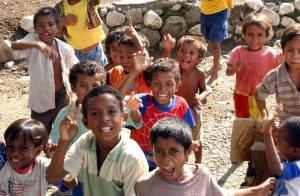
For the remaining days of our stay in the village we make sure that every patrol vocally greets the girls when they walk past. The games of soccer and catch are moved across the road to include the children of the girls. Their delight in being included is heartbreakingly obvious. The other children initially hang back until it is just too hard to miss out on the fun with the soldiers and they raucously join in. At least until one parent or another pulls them out.
On our second last day one of the elders approaches. He is concerned about our interactions with the girls in the house. I assure him that they are not bad girls, not prostitutes. They are our friends just like everyone in the village and like everyone in the village, under our protection. Steve is a little more direct. ‘Fuckin’ leave ’em alone champ’. Or words to that effect. The elder clearly isn’t convinced though.
The next day our reliving platoon arrives. Their Platoon Commander, Lachie, is an ex-bouncer and boxer with an intense demeanor. Like me, he is stoked to be away from Gleno. We run through the defence plan, communications issues – the stupid HF antenna is still giving us grief, villages we have patrolled to and where I think he should concentrate on initially. We walk out to the road and I point out some of the key locations in the village, directions to the markets and central square. Joana and a couple of her friends are out the front of their house. They wave across to us and I wave back. “Who are they?” asks Lachie.
“They’re the Bad Girls.” I reply “They’re our mates.” We walk across to say G’Day.
Epilogue.
We left later that afternoon and never returned to that village as a full platoon. A better location for the Platoon House was discovered up in a place further South and we’d be based out of there in future rotations with the Sections visiting only intermittently as we stretched throughout the region.
Near the end of our tour I visited one of the Company’s sections who were were working out of the original patrol base for a few days. I was talking with the Section Commander when I noticed the Bad Girls house seemed empty and quite. “Where have the girls gone?” I asked.
“Dunno. They apparently cleared out about a month ago when we didn’t have anyone here. No dramas or anything. They just moved on.”
“Humph. I hope they’re alright wherever they are.” I say.
“Yeah me too.” replies the Corporal.
Somehow I think that Joana has probably seen them right. She was a brave and tough lady. I really hope that they are all good, wherever the girls in the house across the way ended up.
 Tales Of A No One Soldier.