Timor, 2003.
The country is all but secure and the international military forces deployed as part of Operation CITADEL are mostly bored, very dispersed and doing their best to help the fledging nation of East Timor – or Timor Leste as we will call it soon – figure out their way ahead.
The Timorese are a warm, friendly and generous people. Almost without exception they are happy to have thrown off the yoke of the Indonesians. They are free to vote for who they want to be their leaders, free to live in their own country after hundreds of years of Portuguese colonisation and Indonesian occupation, free to practice their faith – the vast majority of Timorese being very Catholic. The Australian soldiers of AUSBATT VII (Australian Battalion 7) are still a matter of curiosity though, a welcome distraction and for the children, a source of food, maybe even some chocolates for those who can con it out of their visitors. It’s hard to refuse them most of the time – they are pretty funny and it makes us feel good; everyone wins. The Timorese’ sense of enthusiasm for what lies ahead is palpable even though most of the population outside of the capital Dili live a subsistence and agrarian life.
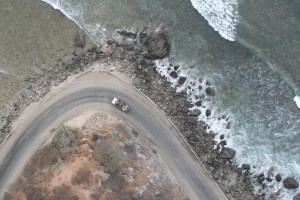
Dili itself sits on the North coast of the island. In 2003 it still bears the scars of the deadly 1999 conflict, burned landscapes, broken houses, unemployed people and poverty. It is the biggest city in Timor and was the focus of development during the Indonesian occupation who, like the Romans, brought roads to their occupied lands. The roads that link Dili and the neighbouring districts either hug the meandering coastline with it’s white beaches and crystal clear water, or head zig-zag like into the jagged hills to link to the district centers and countless villages that cling to the mountain sides and are dotted across the valley floors.
As a 24 year old Infantry Lieutenant, I am as equally as confident and enthusiastic about what is ahead in Timor. Having spent the first half of the tour ensconced in Battalion Headquarters as a Staff Officer waiting for my company to rotate in I am excited to get out and about. After a month or so in the hills of Bonbanro, Delta Company gets a new task. The Portuguese are withdrawing their remaining Army units and we will be taking over their Area of Operations.
Our new stomping ground is the Ermera Region. The mountainous region just behind the border districts and rumoured to be the stronghold of the Fretlin resistance during the years of occupation. The Company will base out of regional capital Gleno, but at least two platoons will be roving the hills to help keep the peace. This is a sought after role – it gets us away from a combative and toxic Company Headquarters (more on that in a different tale) and a chance to operate on our own.

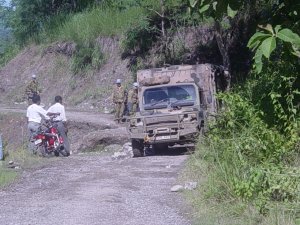
My platoon, 12 Platoon, is tasked to relieve a Portuguese element deep in the hills. We are given a rendezvous location in a small village, vehicles, a rough plan for the next two weeks and leave Bobonaro loaded up for our new adventure. Within a few hours the winding roads are causing us issues. It is the wet season. Land slips are common on the narrow bitumen, and the road rules and sense of mortality of the Timorese drivers seem to be non-existent. As we cross one land slip I stand, much to my Platoon Sergeant’s chagrin, between the vehicle and the drop off. My theory is that if the vehicle rolls with soldiers inside it’ll be better it takes me with it so I can avoid the inquiry and paperwork that would follow. My Platoon Sergeant, Steve, is pissed because it would leave him with the paperwork instead! But we get there in the end and meet the Portuguese.
As excited as we are to arrive, they are as happy to leave. At this stage in their history the Timorese like pretty much everyone apart from the Indonesians due to their recent brutal occupation, the Portuguese for their colonisation, and the Japanese for their inhuman atrocities in World War II. The latter makes life interesting for the Japanese Self Defence Force Engineering Company who have deployed with us. The Portuguese are the most ‘popular’ on that totem pole of distrust, but home is a long way away for them and they are happy to be heading back there.
I sit down with my Portuguese equivalent and go through the handover. We will occupy the same ‘Platoon House’ as they did – an abandoned building whose main attractions were its full roof, solid walls and enough room to park our vehicles off the road – and patrol roughly the same area. There has been no real militia activity here since 2001 although there are plenty of reports to suggest otherwise. The Portuguese Lieutenant believes most of these reports to be attempts to get a United Nations presence into the area from still spooked local leaders, or ‘get squares’ trying to get competitors arrested. The Aussie Diggers will soon call them ‘Militia Ghosts’. Rumour and innuendo are still rife in a country where communications and stories are transported along the roads more than the airwaves.
Towards the end of our discussion the Portuguese Platoon Commander is talking me through the structure of the local hierarchy. The village elders live here. The local priest lives here – he travels to other villages a lot. This is where the market is – we’ll smell it before we see it. “And this is the local whore house.”
“Excuse me, the what now?” I ask.
“Ehhhhhh. . .is. . .prostituta. . .prostitute. Whore house. Bad girls. The villagers. . .do not like them. . . .you must keep soldiers away. This one is bad news.”
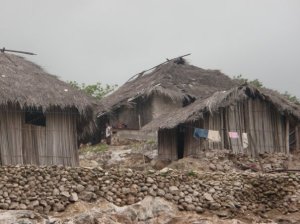
Soldiers and prostitutes have been mixing since Abraham was a Reserve Subaltern at the local depot at Ur, but this was not a situation I was expecting to face in the hills of Timor. I look out to the house the Portuguese Lieutenant has flagged. It is situated diagonally across the way from our base, which itself is set back 20 meters from the road. It’s a dilapidated house even by post-1999 Timor standards, althought it does have concrete walls which is a rarity in these parts. At some stage it has been torched or fire bombed and the scars of those flames are evident around the window and door frames. The roof is mostly intact but one corner has collapsed and exposed the skeleton of the frames to the elements. Like most of the houses – including ours – there is no electricity or running water. As I look from afar, a young woman comes out of the front door and slumps down on the stairs.
“Prostituta,” hisses the Portuguese Platoon Commander. “The elders do not like them. Stay away.”
Suitably warned, we move onto other points of discussion. Where the Portuguese have recently patrolled, water sources, communication blackspots and the like. My Platoon Sergeant and Section Commanders are doing the same with their counterparts. At various times I notice most of my Platoon walk out and have a look at ‘the prostitutes house’. Clearly the word has gotten out about the girls in the house across the way. Our Portuguese compatriots depart in the late afternoon with enough time to get down to Gleno. My Platoon Sergeant is with me as we wave them off. “So Boss, over to you eh?” he asks. We talk through arrangements for the night time piquet and defences, and start planning the next few days’ patrols. A group of soldiers are trying to erect a HF antenna to link us with the Company Headquarters. As we watch them, one of the young soldiers sidles over.
“Hey Sir, Hey Sarge – did you hear about the girls in the house across the way?”. I glance at my Sergeant. Steve is an old-school Senior Non-Commissioned Officer (Senior NCO) and I know he’ll take care of this situation. “Over to you eh?” I say and walk off. As I do I can hear some fairly direct conversation taking place along the lines of “Right Digger, I don’t care what youse have heard about that house, but fuckin’ hear this son. If you or anyone else goes near that joint I’ll fuckin’ hoist ’em from the top of the antenna by their balls and ask forgiveness later? Understood. Spread the fuckin’ word.”
Walk softly and carry an Infantry Senior NCO I say.
We settle into a routine as best as we can. The Australian uniforms are a curiosity. Australians passed through here in the early days of INTERFET but as best we can figure out, it’s mainly been the ground of Brazilian and the Portuguese forces since then. A constant flow of visitors, village elders and kids crowd near the houses and our vehicles, squatting down and chatting among themselves. The Diggers break out tennis balls to play catch and the odd soccer ball for games with the kids. I talk with the elders as patrols exit the base and return. The girls in the house across the way keep their distance but watch from their balcony as well. Occasionally small kids tumble out of their building and play separately to the other village children in the open garden beside their home. Once, I witness what seems to be a heated exchange in Tetum, the Timorese language, between a local man and one of the girls. The girl, who I’ve pegged as one of their leaders from the way she bosses the others around their chores and cleaning around the outside, is chided by the man as he walks down the street. She fires back voraciously and doesn’t back down when then man replies more heatedly. There is no love lost here.
A week later and we are familiar with our area. The Rifle Sections are off for a few days at a time to visit other nearby villages and we make sure we patrol our ‘home’ village and surrounds at least once a day. Communications are difficult and on a few occasions we’ve sent patrols down to Gleno to carry important messages when the radios fail us. As well as written orders, the soldiers bring back news and rumours from Timor and around the world – it is this way that we find out that the war has finally kicked off in Iraq. The soldiers are getting to know who is who and engage with the Timorese as they move around. Their pidgin-Tetum mixed with the locals’ knowledge of English gets us by in most conversations and for the serious ones I rely on Jimmy, a Lance-Corporal of Phillipino origin who has been taught Tetum on a course back in Australia. Most of those conversations are around security of the markets and roads, the ‘ghost militia’ and other sundry items. A couple of times I broach the subject of the girls in the house with the village elders and one time with the Priest but I’m always stonewalled or shut down. They are simply ‘bad girls’, ‘borbelata’ or ’ema la gosta’ – not welcome.
As I sit out the front of our patrol base in our second week, a foot patrol returns and passes by the girl’s house. ” Bon dia. How are ya?” asks the Section Commander to the girls out the front. They giggle and duck behind their balcony wall. The patrol continues into our front yard and the soldiers go through their return to base routine, unloading weapons and checking gear. The Section Commander, Craig, pulls up a chair beside me, takes out a cigarette, sees my look of disdain and stores it behind his ear instead of lighting it. “Pretty quiet as usual Boss. Markets are all good. Nothing doing. I’ll get the notes together for the report later.”
“No dramas mate.”
“Hey Boss. So I was thinking. The girls in the house across the way. The prostitutes? Well for a prostitutes’ house you never see a bloke going near the place day or night right? And they don’t seem to go anywhere but the market. Bit weird for prostitutes eh?”
I’d been having similar thoughts in the past day. The Timorese are very Catholic, particularly in the mountains regions outside the cities. They are patriarchal, conservative and revere the Church. While they may wear torn and tattered clothes in the fields, every family has a set of ‘Sunday Best’ that they wear to Church Services on the Sabbath. The Catholic Church and it’s dogma are a guiding light for much of the lives of the Timorese. The Portuguese are not too different either having been the ones who ‘spread the word’ of Catholicism most recently in Timor. Maybe some old prejudices at play there? Something was up though and the girls in the house seemed to cop a bit of abuse as a result. “Have a look around mate. See what you can find. Maybe take Jimmy for a chat. . . . . .Outside the house.” I tell Craig.
The next day Jimmy and Craig find me after paying a visit to the girl’s house. “Hey Sir, the Boss Girl doesn’t want to talk to Jimmy and me. She’ll speak to our ‘Tenant’ though she says!” Craig informs me. “Better get across then I guess.” I reply.
I head across the way to speak to the girls. I’m now really curious as to what is going on here. I’m not sure what to expect and I’m pretty certain this situation was not covered in our pre-deployment training. Now or never I guess – I need to find out what is going on before we rotate out of here at the end of the week: Should I be protecting these girls? Protecting the soldiers? Doing. . . something. . .I have no idea.
To be continued.

 Tales Of A No One Soldier.