In early 2011 I was standing behind a chest high wall in the Tangi Valley, Deh Rawud District, with my binoculars glued to my eyes. I was searching for the movement of my troops on the far side of the valley as they advanced towards the enemy. Somewhere behind me elements of our Infantry Platoon had been pinned down by accurate machine gun fire and had taken cover behind some small walls on a hill side as we planned our next move. The crack and thump of bullets passing overhead let us know that the enemy were still in the fight, still intent on keeping the Infantry Platoon pinned. At my feet, my ‘Terp’ – short for interpreter – squatted down beside me with his hands loosely covering his ears.
“Hadi* what are you doing down there?” I asked. The young Hazara looked up, apparently not too scared or afraid, smiled and shrugged “If I stand up, maybe the Talibs shoot me” he replied, then discreetly indicated towards some of the Afghan National Army soldiers who were providing fire support nearby “Maybe they shoot me. . . . . .maybe you shoot me.” This last comment was delivered with a wide grin as he pointed at my rifle, currently clipped to the front plate of my body armour with the barrel pointed squarely between my feet.
“Hadi if I shoot you who is going to do all the talking for me?” I asked as I went back to my scanning.
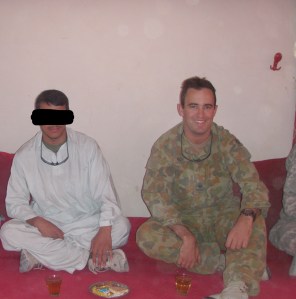
This was the life of the Terp. Unarmed, largely untrained and sometimes even unloved by their own countrymen, they would accompany Australian soldiers into harms way. Many of them worked on multiple tours and for multiple bosses over many years. The pay might have been relatively good compared to the average wage of an Afghan, but the dangers were horrendous. Late in our tour I was engaged in compensation discussions with a group of village elders. They had arrived at our base en masse after a civilian had been wounded in a raid by Coalition Special Forces. The wounded man was evacuated to medical facility and lived but the ‘eye for an eye’ mentality required action from his family. I went out to discuss the situation with them accompanied by my Intelligence Officer, Dean, and Terp. To show trust and openness I removed my body armour and sat down in my best impression of crossed legs. Food and tea were offered to our visitors and refused – not a good sign. The elders stated their case, and the negotiations began as to what would be considered appropriate compensation. After a bit of back and forth I noticed one of the more previously friendly elders speak into the ear of the lead Afghan negotiator. Beside me, my Terp quickly scootched behind me. “What did he say?” I asked him. “This one said that perhaps as compensation they could shoot you in the stomach. . . . . . or me.” came the nervous reply. We managed to avoid that outcome.
For someone like Hadi, serving as a Terp for the Coalition forces could be even worse. As a member of the Hazara tribe he was regarded as sub-human by the Taliban and a lesser man at best by most of his fellow Afghans. In the complex tribal politics at play in our area, Hadi could never really let his guard down except when he was behind the walls of Forward Operating Base Hadrian with the Australians and Americans. Most of the Afghan Army in the Battalion we worked with were Pashtun who had no love for the Hazara as a rule. The locals were a stew of Pashtun sub-tribes whose distrust of each other was surpassed only by their hatred of the Hazara.
Hadi had personal experience of this hatred. His father and mother had been killed in a Taliban attack in their home district of Bamiyan a few years earlier. Hadi’s sister and he had escaped the carnage but shortly after she had moved to Australia with her husband, promising to send for Hadi soon. That had proved impossible as he swiftly moved between family homes and villages with one eye always open for those who wanted to kill him. Through school and desperate experience Hadi had learnt and taught himself English, finding his way into the employ of a company who provided interpreters for Coalition forces. Perhaps because of the Australian connection with his sister, luck or something else, Hadi had ended up with Combat Team – Charlie in Deh Rawud district.
Here he had initially worked with one of the Mentoring Teams who toiled day to day with the Afghan National Army. Speaking excellent English, Farsi and Dari, Hadi quickly became a star. He had a good understanding of the dynamics at play. As well as the literal interpretation of what was being said, he could provide context and nuance to the often-difficult conversations between the Australian and Afghan allies.
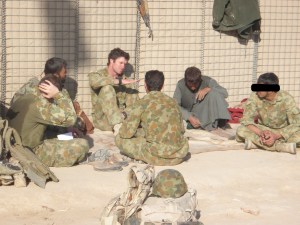
For his sins, I picked Hadi to be my interpreter after the local Afghan Army Officers had strongly suggested that my previous Terp was no longer welcome at their base after a disagreement. Working with me as the Combat Team Commander was no dream job for an interpreter. A linguist myself, I was demanding in what I wanted and how I wanted it. My Terps had a massive and exhausting workload, engaging with District and Tribal leaders at the many meetings I took part in, working with the leadership of the Afghan Battalion we mentored and having to follow me wherever I went. This at times put them in positions they didn’t want to be in. As one Terp told me when requesting to rotate back to his previous team ‘You get shot at too much.’
They did all this with no real military training in how to move in combat apart from what we could pass on during our down times in the bases, or that they learnt ‘on the job’ by getting shot at and not hit. They wore the body armour and helmets that were available. Sometimes the equipment was even the right size.
On top of all of that, Hadi was suspiciously young to be working for us. Policy required that all Terps be at least 18 years of age. Hadi had worked for different Australian rotations for at least a year prior to our arrival, than a further five months during our tour before joining me in the Headquarters. And yet he was still ‘only 18’ apparently. I asked him about this one day and he said that being ‘18’ meant he could get a job that paid good money and that he had been able to submit his paperwork to immigrate to Australia. “You’re definitely 18 now though?” I asked. “Oh definitely Boss!” he said with a roll of his eyes.

Getting to Australia was the be all and end all for Hadi. Australia was safety, his remaining family, a future where he didn’t have to fear for his life constantly just because he was born into the ‘wrong’ tribe. Hadi had submitted his immigration paperwork to the Australian Embassy in Dubai 12 months previously, but nothing had happened. Once the Diggers of Combat Team – Charlie spent time with Hadi and heard his story they raised their concerns with their leaders and pushed his case. Questions to the employment company about how they were assisting were not answered. The Australian Officer in Tarin Kowt charged with managing the Terps was also stonewalled when she tried to assist. I even emailed the Embassy myself and was told that Hadi’s application would be processed in due course. Not reassuring.
As time passed Hadi was getting more and more anxious and spoke of his plans to make the journey to Australia by himself. I actively discouraged him from that idea. The route would have seen him travel through Afghanistan and then onto Pakistan and India. He would then need to attempt to find his way down to Indonesia and then Australia. The first part of the journey was deadly for a Hazara – especially one who had worked for the Coalition Forces – the last equally perilous with no guarantee of even being allowed to enter Australia if he even made it at all. When I finally took my leave after six months I dragged Hadi aside who was heading off on his own break. We both knew he was going to do a runner as soon as he got to Kandahar but I tried to dissuade him from that. “Wait it out. Stick with us and we can get you there legally and properly. I’ll get you a safer gig when we get back” I said. “Sure Boss, no problem.” he replied. But the shrug and the smile were gone.
Two weeks later I returned from my leave. Hadi was nowhere to be found and we never saw or heard from him for the remainder of our tour. He had disappeared.
Late June saw me back in Darwin after almost ten months on operations. Following some final admin I was doing my best to settle back into a home life with a four year old who was permanently attached to me, an 18 month old who had no idea who I was suspiciously eyeing me off all the time and an exhausted wife who had kept it all going while I was away. As part of my ‘returning to normal’ I would tell my wife and parents our stories from the deployment, including those of the Terps who served us so bravely. They too worried for Hadi.
And then the phone rang. “Is this David French? This is John^ from Border Force. I’ve got a submission from an Afghan boy named Hadi who reckons he worked for you overseas. He looks too young though. He needs a character reference to help confirm his identity and bonafides.”
“Hadi? Yeah I know him. Where is he? Kabul? Dubai?”
“Darwin mate. He’s in the detention centre.”
The bugger had actually beaten me home.
Hadi had survived the journey from the dust of Deh Rawud and made it to Jakarta through a combination of hitchhiking, cars, buses, and a plane ticket paid for with most of his money he earned as a Terp. Staying a month in Jakarta to earn more cash, he had been able to link up with people smugglers and buy a ‘ticket’ on a boat that was apparently headed for Australia. The small, leaky craft was intercepted by the Australian Navy and somehow Hadi had been brought to detention in Darwin instead of being shipped offshore.
After picking my jaw up off the floor I quickly confirmed with the Border Force officer that I could visit Hadi and bring in some supplies. I informed my chain of command and then went shopping but I quickly stalled. What do you bring to someone in detention who you served in a war with? How do you say welcome home if you don’t even know he’ll be welcome? You can’t really, but with a combination of clothes, magazines, food and drinks we did our best. The reunion was half-joyful and emotional and half-difficult. We discussed our past adventures, plotted Hadi’s path to join his sister and what assistance we could provide. There were also long silences as we contemplated the difficulties ahead. Before I left I had a chat with the Border Force senior officer on duty ‘Take care of that kid. He took care of us overseas. We can’t send him back and we can’t send him to Malaysia or PNG.’
In the days that followed I received another surprise phone call. This one from an officer on the Brigade Headquarters passing on a message from above: I was not to visit Hadi again or make a deal of his arrival in Australia. There had been a number of Terps who had made the same journey and others who had absconded on a recent military visit and there were concerns over. . . . .I honestly don’t know what. I was pissed off and may or may not have followed that order to the letter. But I was hamstrung as well. How could we abandon this kid who had been through as much as any of us?
Hadi eventually got out of detention and the last I heard, lives in the South East of Australia having finally reunited with his sister. He and a number of other Combat Team – Charlie Terp’s are settled in their new homes here, safer than they have ever been. But there are others who are not, and we don’t know where they are.
We owe a debt of honour to those Afghan’s who put their lives on the line with our soldiers and for our soldiers. The job of Terp could be a thankless and dangerous task, but it was essential for the safety of our soldiers and the success of the mission on a day-to-day basis. With many now facing an increased threat of execution at the hands of the resurgent Taliban we need to bring them to Australia if they so choose it, or help them resettle elsewhere if that is what they desire. It is the right thing to do. It is the honourable thing to do.
Get them safe. Bring them home. Leave no one behind.
*Name has been changed for privacy and safety reasons.
^Name has been changed because I can’t remember it!!
 Tales Of A No One Soldier.