The Valley.
Four young Australian soldiers stand opposite me. The twists, turns and contours of the Tangi Valley are captured in detail in maps on a table between us. The maps are marked up with arrows and symbols displaying what we know about the enemy and civilians living in there. There are not many of these markings. There need to be a lot more. Jim Creighton, the US Commander of Combined Task Force Uruzgan, has told me to clear the valley before the year’s end. It has been held by the Taliban without any real sustained coalition presence for almost a decade. Two months before Dan Keighran and his brothers had fought there in the action that led to him being awarded the Victoria Cross. On our tour – although we don’t know it yet – our own battles will lead to the awarding of two Medals of Gallantry, numerous Distinguished Service awards and a number of other commendations. Recognition for bravery in action against a determined, skillful and evil enemy.
The four soldiers I’ve just briefed are a touch less ‘regi’ in appearance than the average Digger. More reserved in thought. Perhaps more considered. They are snipers. In one corner of the briefing room their body armour is stacked against a wall. It displays a patch – which I curse under my breath I will have to tell them to remove again before someone who cares sees them – stating that snipers are “Feared by many”. I’ve just given these soldiers orders that will see them push further into the valley and stay there longer than any coalition force has done in years. Potentially these orders will send them to their deaths.
“So Boss, to confirm, you want us to insert into the Valley, past Derapet, set up an observation post and establish pattern of life as best possible in Karakak E-Sharqui, Tutak, Deparet and wherever else we can? 72 hours?” asks Corporal Marc “Danny” Danieletto, their Team Leader.
“Correct. I need to know what is really happening in there. We need to establish what is normal and what is not. To see how the villagers and enemy act when they think they are not under observation.” I’ve detailed a list of things that we need to identify: village habits, meeting points, targets, movement of arms, stores. “If we don’t get this info then we are going in almost blind, we will have to fight more, we will be in greater danger as will the civilians. I need this info boys.”
The soldiers look back and forth between each other. I’ve just told them they are going in alone into one of the most dangerous areas in Uruzgan. They will be at least an hour by foot from any reaction force, no landing zones are close by and if it all goes bad, fire support will be difficult if not impossible. They will be completely alone save for our voices at the other end of their radios. It is the most dangerous mission we have undertaken to this point. But they understand how vital it is for our protection and for the innocent people around us. If we don’t know this information by the time we launch, we could get stuck in a very bad position in that valley.
Their mission and purpose, is as clear to them as the danger. “Got it Boss.” Says Danny “Give me a day to plan and we’ll get back to you.”
Figuring it out, plan it out.

Just as if we had plunged into the Tangi Valley without figuring out what we knew and what we didn’t know, if a veteran plunges into the private sector with no research or understanding of their new environment it will not usually go well. It can be a dark and twisted valley that is hard to get out of.
In the military your mission is clear and it is given to you. It is set out in mottos, duty statements, missions and task verbs. You can find a reason and direction for almost everything. Each little thing builds towards a bigger goal – even if you don’t like it at the time. When you leave the military that whole paradigm changes and veterans need to understand – really understand – that you get the big vote in what you do and where you work. Many of us struggle because we try to equate our service in the military with work in civilian life; to compare two vastly contrasting career paradigms. I’m finding trouble trying to explain it even now (Sorry!).
Work and life outside of the military is not a mission – something that has a definite end state, task and resources. This is a pitfall that many veterans fall into when trying to find their new careers. It might by your ‘why’ as Simon Sinek put it. I personally prefer the term ‘purpose’. Because ‘purpose’ is the activities or things you do in order to be fulfilled at home, at work and in life. No one is going to figure out your purpose for you. It is all on you.
Why do you need a purpose?
There are arguments for and against defining your purpose. For veterans, I would suggest that having a purpose is incredibly important in finding your place outside the military. With so many career options available, knowing with some degree of certainty that what you are doing is going to make you fulfilled is critical. Too many times I have heard about veterans jumping from role to role, unhappy in all of them. Did they know why they were working in those jobs? Was it just about earning the dollars? Did it make them fulfilled??. . . . You would say not.
Having and understanding a purpose will give you a sense of control. It will help you define the types of roles and jobs you are looking for. It will help you look beyond just work, to where else you can make a contribution and find enjoyment and fulfillment. Purpose is about more than just work. It is something that is built by you, not given or taken from somewhere or somebody else. Having a purpose will stop you getting caught in the valley.
A popular theory tells you to find what you love, and then find a way to make that pay for you. Well I love playing rugby, but as many of my team mates over the years can attest, I am rubbish at it. Scratch that theory for many of us. Another idea is to find what you are best at in life and do that. I think I am pretty good at infantry minor tactics and combat leadership but the need for that in the private sector isn’t high and I’d spent enough time away to not need to do that again. So I had to figure out what my purpose was. What was going to make me fulfilled at work and home, give me pride in what I was doing and not send me crazy in the process.
Finding the way.
When I decided to leave the military I sat down and asked myself some hard questions. I talked to my family, mates, peers and mentors who were already out and asked them the same hard questions. This was a new valley to recon, to figure out. I found my purpose like this:
- I listed areas where I thought I could make a difference and find meaning in work. Consulting was a pretty obvious one and where I ended up but I looked far and wide. I talked to banks about security related roles; Learning and development organisations about training and education; Big defence industry companies about what they did. I looked at the energy and resources sector and even management roles in fast moving consumer goods companies. I didn’t limit where I thought I could work based on the role I had in the military. I knew I could do more – as can any veteran.
- I stopped looking for a job title (after a while). You’ll need to look at job titles eventually but first, figure out what it is that will make you fulfilled by considering work actions and activities you want to do. What makes you happy when you are at work? Working in a team? Working by yourself? Running a workshop? Writing? Physical activities? Helping others? Crunching data and numbers? What type of thing do you want to do again and again? A title is only as important as you make it to be – the what of any job is the key part.
- I forgot the dollars and tried to get it all to make sense. A common lament from veterans is that they have to take a pay cut when leaving the Defence Force. Maybe, maybe not. But what you need to understand is what other benefits are available. Like not spending five months a year in Shoalwater Bay or longer on deployment. Reserve leave, study leave, parental leave, true flexible work options. My eldest son was 10 before I had spent as many of his birthdays with him as I had been away for, my new career wouldn’t be allowed to do this. You can always end up earning more pay, but not more time.
- I researched the organisations that I thought I wanted to work with. Look hard at what companies espouse as their values. Do they use those as part of their normal routines or are they just words on a wall. Do they align with what you want to do and how you want to do it. Your purpose must align as best possible with your employers. By doing this I ruled out two large companies that on face value had looked attractive, but on closer investigation paid scant regard to their employees.
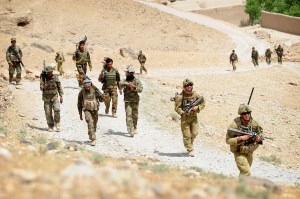
Out of the valley.
The right role or company won’t just find you. With all the career options out there it is easier to find the wrong one then the right one unless you put the effort in. You need to think about what you want to do and where. And it is not all about where you work. My purpose is fulfilled not just by working as a consultant, but in coaching my kids’ sports teams, fundraising for different charities, helping mentor veterans and also those who want to join the Defence Force. My purpose is about me as a person and not just the job – it took a lot of planning, questioning, patience and mistakes to figure that out.
After.
A week after our initial planning session the snipers climbed back down from their mountain. They had stayed in location, undetected, for 72 hours. They had gained vital information that fed into our planning for the massive clearance operation we would launch with our American and Afghan brothers just after Christmas 2010. They knew what they had to do and why.
A clear purpose gave them direction in work and allowed them to do what they were good at.
NAFT.
This blog was originally published on LinkedIn on 20 October 2019.
 Tales Of A No One Soldier.
Pingback: Keep Your Tribe. | Tales Of A No One Soldier.